How To See The Northern Lights In The UK
Chase the aurora without leaving Britain. The best UK viewing spots, timings, forecasts and photography tips to see the Northern Lights from home. Read more.
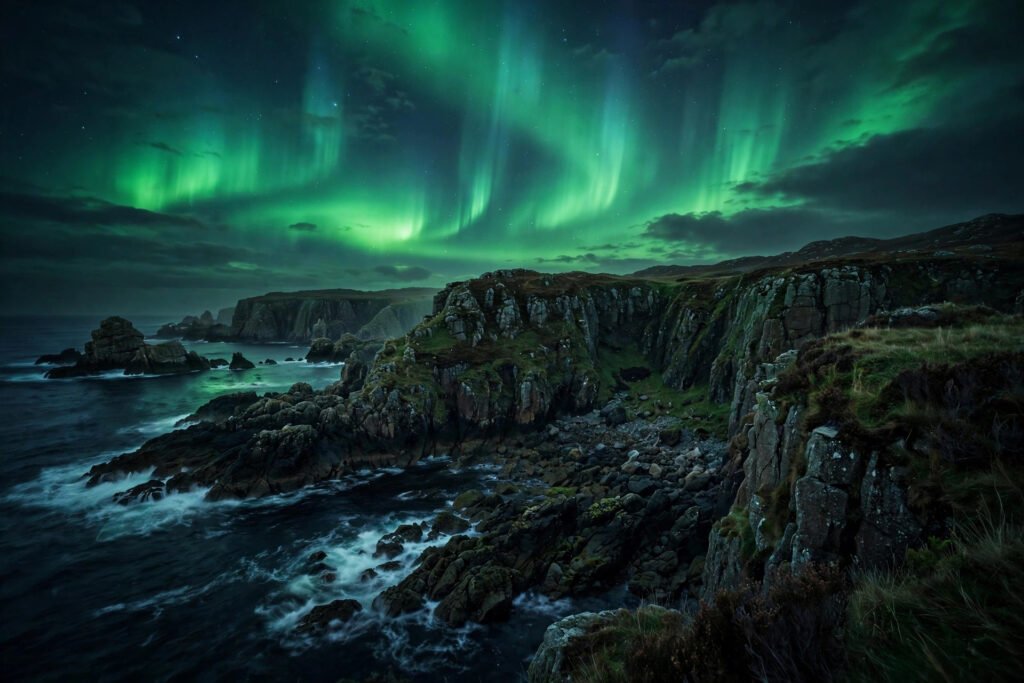
Most Britons assume the Northern Lights are something you fly to Iceland or Norway to see — an expensive bucket-list trip, not a Tuesday night possibility from a layby in Northumberland. But the aurora borealis regularly dances over British skies, and in 2026 we are near the peak of the Sun’s 11-year activity cycle, which means displays are more frequent and reach further south than usual. People have photographed vivid auroras from Norfolk, the Midlands and even Kent in recent years. Seeing them from the UK is absolutely possible — it just requires understanding what makes them appear and being ready when the conditions align.
This guide explains the science in plain English, when and where your chances are best, how to read the forecasts, and the practical details — from layering for unpredictable UK weather to camera settings — that turn a hopeful drive into a successful night.
What Causes the Northern Lights
The aurora begins 150 million kilometres away, on the Sun. Our star constantly streams charged particles into space — the solar wind — and occasionally erupts in coronal mass ejections, vast bubbles of plasma hurled toward Earth. When these particles reach us, typically one to three days after eruption, Earth’s magnetic field funnels them toward the poles, where they collide with oxygen and nitrogen in the upper atmosphere. Those collisions release energy as light: green from oxygen at lower altitudes, red from oxygen higher up, and purples and blues from nitrogen.
The strength of the display depends on how disturbed Earth’s magnetic field becomes, measured on the Kp index from 0 to 9. At Kp 3–4, the aurora may be visible from northern Scotland; at Kp 5+ (a geomagnetic storm), it can reach southern England. The Sun’s activity follows an roughly 11-year cycle, and the current cycle’s maximum falls around 2025–2026 — which is why UK sightings have been notably frequent lately. Strong displays are never guaranteed, but the odds right now are the best they will be for a decade.
When and Where to Look in the UK
Timing: the aurora is a night-sky phenomenon, so you need true darkness — roughly September to March in the UK, with the equinox months (September/October and March) statistically among the best. The hours around midnight, give or take two hours either way, are prime. A common beginner mistake is going out at 9pm in October when the sky is still glowing; patience until proper darkness pays off.
Location: head as far north as you can manage, and away from town lights. Scotland’s far north, the Cairngorms, the Isle of Skye and Shetland offer the best odds, but excellent displays have been seen from the Northumberland coast, the Yorkshire Dales, the Peak District and even the South Downs during strong storms. The critical factors are a dark sky and a clear view of the northern horizon — the aurora appears low in the north first, so hills, trees or buildings blocking that direction will hide it.
Weather: this is where most UK attempts fail. The aurora happens above the clouds, so overcast skies mean no show regardless of solar activity. Check the cloud forecast specifically — the Met Office’s space weather pages include aurora guidance, and dedicated aurora forecasts show both the Kp index and cloud cover together. Some of the best UK sightings happen on crisp, cold, high-pressure nights when the sky is clearest.
How to Read the Forecasts
You do not need a physics degree — three numbers tell you everything. First, the Kp index: 0–2 means stay home unless you are in Shetland; 3–4 means northern Scotland has a real chance; 5+ means get in the car if the sky is clear; 7+ means the whole UK should look up. Second, the solar wind speed and Bz (the magnetic field’s north-south orientation): fast wind (600+ km/s) with a sustained southward Bz (negative values) is the recipe for strong displays. Third, cloud cover over your location — no point in a Kp 7 under solid stratus.
Sign up for alerts rather than checking manually: AuroraWatch UK, run by Lancaster University, sends free email and app alerts when activity spikes over Britain, and the Met Office space weather forecast provides official UK outlooks. Set your phone to receive them, keep warm clothes and a flask by the door from September onwards, and be ready to drive on short notice — the best displays often arrive with only an hour or two of warning.
Beyond the official forecasts, the UK has a lively community of aurora chasers who share real-time sightings — social media groups and dedicated apps light up with reports the moment displays begin, often faster than any forecast update. If alerts ping while you are already out, these live reports tell you whether it is worth driving further north or heading home. Just remember that photos in these groups are often long exposures that exaggerate what the naked eye sees; use them for confirmation that activity is happening, not as a promise of what you will witness.
Photographing the Aurora
Here is a delightful quirk: your camera will often see the aurora before your eyes do. Human night vision is poor at colour, so a faint display can look like greyish cloud to the naked eye while a phone camera reveals vivid green curtains. If you think you might be seeing something, take a photo — a 3–10 second exposure on a phone’s night mode, held steady against a car roof or wall, is enough to confirm.
For better results: use a tripod, switch to manual focus set to infinity, keep ISO between 800 and 3200, and expose for 5–15 seconds depending on brightness. Turn off the flash (it does nothing for the sky and ruins everyone’s night vision, including yours). And protect your night vision generally — avoid looking at your phone screen between shots, or use a red-light mode. For the full cold-night experience, proper packing for a cold-weather night out makes the difference between a magical hour and a miserable twenty minutes.
Frequently Asked Questions
Can you really see the Northern Lights from England?
Yes — during strong geomagnetic storms (Kp 5+), the aurora has been photographed from across England, including southern counties. Your chances are far better in the north under dark skies, but major storms make it a genuinely UK-wide event.
What is the best month to see the aurora in the UK?
September, October and March combine dark nights with statistically higher geomagnetic activity around the equinoxes. Deep winter (December–January) offers the longest darkness but also the cloudiest weather, which often cancels out the advantage.
Do I need to travel to Scotland?
Not necessarily, but it helps enormously. Northern Scotland, Shetland and the Northern Isles see the aurora far more often than the south. That said, during the strongest storms of recent years, spectacular displays were visible and photographed from London and Kent.
Why can’t I see the colours everyone photographs?
Human eyes are weak at detecting colour in the dark, so faint auroras look greyish-white to the naked eye while cameras capture vivid greens and purples. Strong displays do show obvious colour to everyone — green curtains and red fringes are unmistakable when the storm is powerful.