What Is Quantum Computing Explained For Beginners
Quantum computing explained for beginners: qubits, superposition and entanglement, plus what quantum computers can actually do, in plain English. Read more.
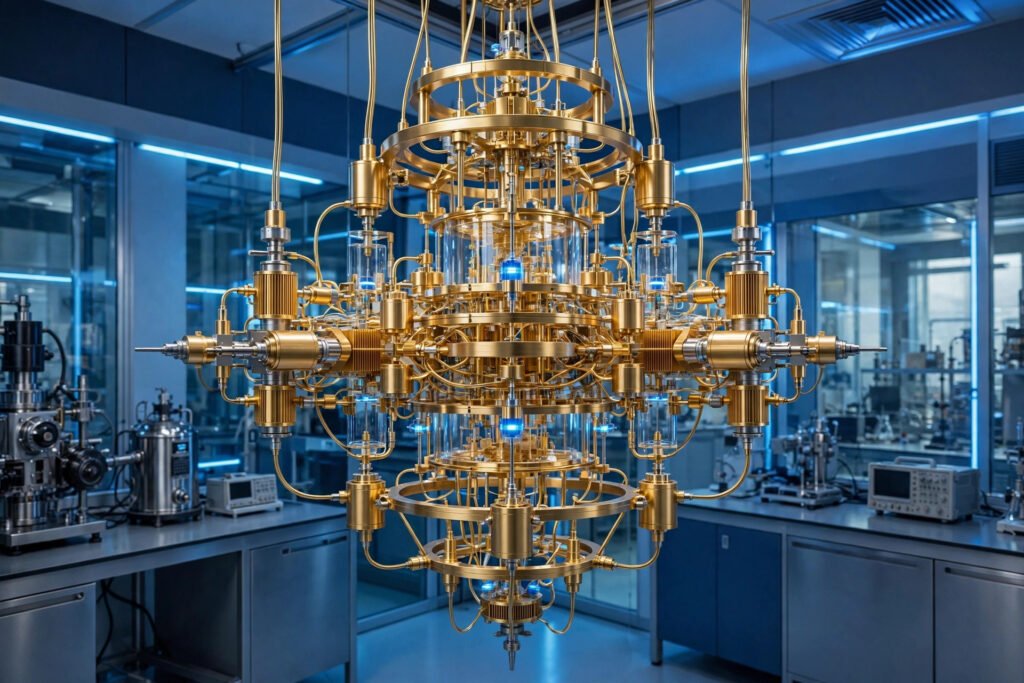
Quantum computing is routinely described as the technology that will “change everything” — which tells you precisely nothing about what it actually is. Strip away the hype and the idea is surprisingly graspable: where an ordinary computer stores information as bits that are definitively 0 or 1, a quantum computer uses quantum bits — qubits — that can exist in combinations of 0 and 1 at the same time. That single difference unlocks a fundamentally different way of solving certain problems, one that could eventually crack modern encryption, design new medicines and model complex chemistry. It will not make your laptop faster or your games prettier. But for specific, important tasks, it could be transformative.
This guide explains quantum computing from first principles — no physics degree required — covering how qubits work, what quantum computers are actually good at, where the technology stands in 2026, and what it means for everyday life.
Bits vs Qubits: The Core Idea
A classical bit is like a coin lying flat: heads or tails, 0 or 1, no in-between. A qubit is more like a spinning coin — while it spins, it is in a blend of heads and tails simultaneously, a property called superposition. Only when you measure it does it “land” as 0 or 1. This is not just a trick of ignorance about which state it is really in; experiments confirm the qubit genuinely occupies both states at once until measured.
The real power comes when qubits are linked through entanglement — a connection Einstein called “spooky” — where the state of one qubit instantly relates to the state of another, no matter how far apart they are. A register of entangled qubits can represent an enormous number of combinations simultaneously: 300 entangled qubits can describe more states than there are atoms in the observable universe. A quantum computer manipulates all those possibilities in parallel through carefully choreographed operations, then measures the result to extract the answer.
An analogy that helps: if you are searching for a name in a phone book, a classical computer checks entries one by one (or a few at a time with multiple processors). A quantum computer, for certain search problems, can effectively probe many entries at once through a process called amplitude amplification — not magic, just mathematics exploiting superposition. The catch, and it is a big one, is that this only helps for particular types of problems. For most everyday computing — word processing, web browsing, video — quantum offers no advantage whatsoever.
What Quantum Computers Are Actually Good At
Breaking encryption (eventually). The famous example: Shor’s algorithm lets a sufficiently large quantum computer factor huge numbers exponentially faster than classical machines, which would break RSA encryption — the mathematics protecting online banking, messaging and government secrets. This is real but distant: it needs millions of stable qubits, and today’s machines have hundreds to a few thousand noisy ones. Governments and banks are already migrating to “post-quantum” cryptography as insurance, which tells you they take the long-term threat seriously.
Simulating molecules. This is the most promising near-term application. Designing a new drug or battery material means modelling how molecules behave — a quantum-mechanical problem that classical computers approximate crudely. Quantum computers speak nature’s own language here, and could one day design medicines, fertilisers and carbon-capture materials far faster than trial-and-error chemistry. Pharmaceutical and materials companies are already running small-scale experiments.
Optimisation. Delivery routes, airline schedules, financial portfolios, power grids — problems with astronomical numbers of possible combinations where finding the best (or near-best) solution matters. Quantum approaches show promise here, though classical algorithms keep improving too, so this remains a genuine contest rather than a settled victory.
What they will not do: replace your laptop, run AI chatbots better (classical chips remain far superior for that), or browse the web. Quantum computers are exquisite specialist instruments, not general-purpose upgrades — closer to a particle accelerator than to the next iPhone.
Where the Technology Stands in 2026
Quantum computing is past the “is it real?” stage but well short of the “is it useful?” stage. The landmark 2019 “quantum supremacy” experiment showed a quantum processor solving a contrived problem faster than any supercomputer; since then, progress has been steady but unglamorous — the real battle is against noise. Qubits are exquisitely fragile: heat, vibration and stray electromagnetic fields corrupt them in microseconds, which is why quantum processors live in dilution refrigerators colder than deep space.
The field’s central metric is now error correction — using many physical qubits to create one reliable “logical” qubit. Recent demonstrations have crossed important thresholds, with logical qubits finally outperforming their physical components. The UK is a serious player here: the government’s National Quantum Strategy has committed over £2.5 billion across a decade, with hubs at Oxford, London and Glasgow, and British firms among the leaders in trapped-ion and photonic approaches. The UK National Quantum Strategy sets out the ambition to make Britain a world-leading quantum economy.
Realistic timelines from researchers: small, useful quantum advantages in chemistry simulation within this decade; cryptographically relevant machines (the ones that threaten RSA) likely 10–20 years away, if ever. Anyone selling you certainty about dates is selling something. For context on how transformative tech actually arrives — gradually, then suddenly — the difference between AI and machine learning is a useful parallel: the terms were confused for years before the technology matured into AI’s role in everyday life.
What It Means for You
For most people, quantum computing’s effects will arrive invisibly, embedded in products and services. Your bank will quietly upgrade its encryption; new medicines may reach trials faster because of quantum-designed molecules; logistics networks might run slightly more efficiently. You will never own a quantum computer — they will live in data centres, accessed via the cloud, much as IBM’s quantum systems already are today for researchers.
The one area worth personal attention is digital security hygiene: the long-term shift to post-quantum cryptography is underway, and keeping devices updated ensures you benefit as standards roll out. Beyond that, quantum computing is a spectator sport for now — fascinating, genuinely important, but not something that changes what laptop you should buy or what career your teenager should choose. Classical computing, and AI running on it, will shape the next decade far more directly.
Frequently Asked Questions
Will quantum computers replace normal computers?
No. Quantum computers are specialists that excel at specific problems (molecular simulation, certain optimisation, factoring large numbers) and are useless at everyday tasks like browsing or word processing. Classical computers will remain the workhorses; quantum machines will be cloud-accessed accelerators for particular jobs.
How close are we to quantum computers breaking encryption?
Years to decades away. Breaking RSA-2048 needs millions of stable, error-corrected qubits; today’s machines have hundreds to low thousands of noisy ones. Banks and governments are already migrating to quantum-resistant cryptography as a precaution.
Why do quantum computers need to be so cold?
Qubits are incredibly fragile — heat, vibration and electromagnetic noise destroy their quantum states in microseconds. Dilution refrigerators cool processors to near absolute zero (colder than deep space) to keep qubits stable long enough to compute.
Is the UK involved in quantum computing?
Yes, significantly. The UK National Quantum Strategy commits £2.5 billion over ten years, with world-leading research hubs at Oxford and elsewhere and British companies pioneering trapped-ion and photonic quantum hardware.