How Does Sunscreen Protect Your Skin Scientifically For UK Families
The science of how sunscreen protects your skin: UV filters, SPF ratings explained and why daily protection matters under British cloud cover. Read more.
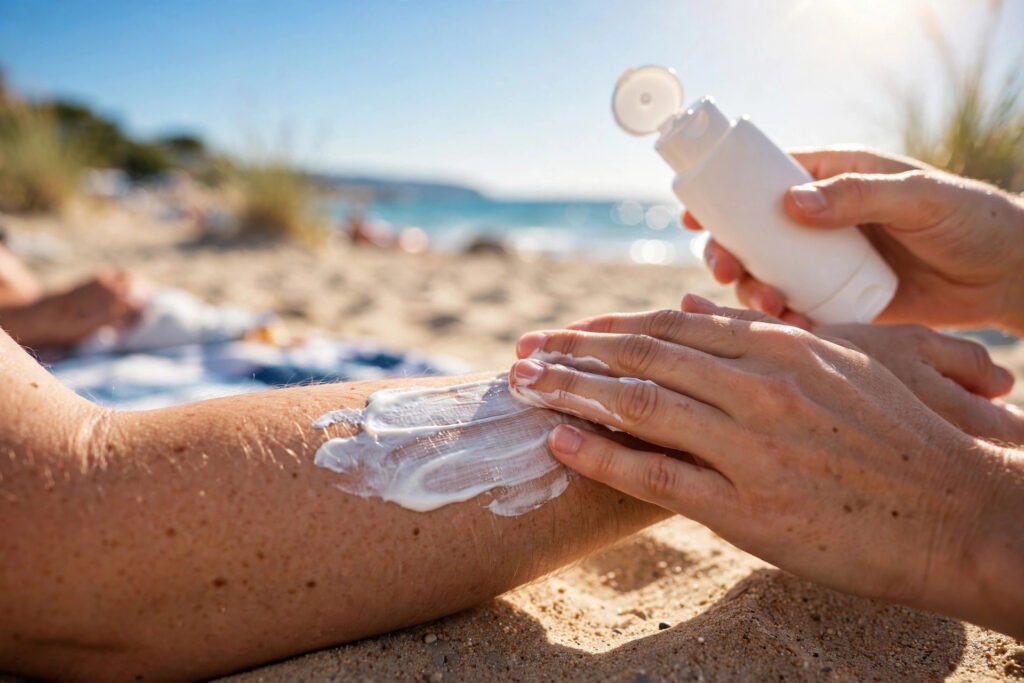
Most of us apply sunscreen with the vague understanding that it “blocks the sun” — and then promptly undermine it by using too little, applying it too late, and trusting it far longer than we should. But what sunscreen actually does, at the molecular level, is genuinely fascinating: it is a thin film of chemistry that intercepts high-energy light before it can damage your DNA. Understanding the science is not just interesting — it changes how you use the stuff, which is the difference between real protection and a false sense of security.
Here is how sunscreen protects your skin, what those numbers and labels really mean, and how to get the protection you are paying for — including the practical sun protection habits for UK skin that matter most in our deceptively mild climate.
What Sunlight Does to Your Skin
Sunlight contains ultraviolet (UV) radiation in two main forms that reach us. UVB rays are the shorter, more energetic ones: they penetrate the outer skin layers, cause sunburn, and directly damage DNA in skin cells — the damage that can lead to skin cancers, including melanoma. UVA rays penetrate deeper, into the dermis: they do not burn as readily, which makes them sneakier, but they break down collagen and elastin (causing premature ageing, wrinkles and sagging) and contribute to DNA damage and skin cancer risk too.
Here is the part most Britons get wrong: UVA is present all year round, penetrates cloud, and passes through window glass. You are exposed on a grey February day in Manchester, just at lower intensity. UVB varies more dramatically — it peaks midday, in summer, and at lower latitudes, which is why British holidaymakers burn so spectacularly in Spain. Both types matter, which is why modern sunscreens must defend against both.
How Sunscreen Intercepts UV: Two Mechanisms
Sunscreens protect you through two completely different chemical strategies, and most modern products combine both.
Chemical (organic) filters — ingredients like avobenzone, octocrylene and homosalate — work by absorbing UV radiation. Their molecules are structured to soak up high-energy UV photons and convert that energy into a tiny amount of heat, which dissipates harmlessly. Think of them as molecular sponges tuned to specific UV wavelengths. Different filters absorb different parts of the spectrum, which is why sunscreens blend several: avobenzone is excellent against UVA but degrades in sunlight unless stabilised by companions like octocrylene.
Mineral (inorganic) filters — zinc oxide and titanium dioxide — work primarily by absorbing UV too (despite the popular “reflective shield” description, modern research shows absorption dominates, with some scattering). They sit on the skin’s surface rather than being absorbed into it, which is why mineral sunscreens suit sensitive skin and why they leave the infamous white cast — the particles are literally visible. Newer formulations use micronised particles to reduce whitening while maintaining protection.
Neither mechanism is instant: chemical filters need roughly 15–20 minutes after application to form a proper protective film, which is why “apply before you go out” is real advice, not marketing. And no sunscreen blocks 100% of UV — SPF 30 blocks about 97%, SPF 50 about 98%. The difference between 30 and 50 is smaller than most people think; what matters far more is applying enough and reapplying.
Decoding the Labels: SPF, Stars and Broad Spectrum
SPF (Sun Protection Factor) measures protection against UVB — specifically, how much longer you can stay in the sun without burning compared to unprotected skin. SPF 30 means, in theory, 30 times longer. In practice the number is less important than the behaviour: most people apply a quarter of the tested amount, which can turn SPF 30 into an effective SPF 8.
The star rating (on UK and EU products) measures UVA protection relative to the SPF — five stars means the UVA protection is at least a third of the UVB protection, the recommended balance. A high SPF with a low star rating protects against burning while letting ageing, deep-penetrating UVA through: exactly the wrong trade-off. Always choose high SPF with four or five stars, or products labelled “broad spectrum”.
Water resistance means the sunscreen retains a stated proportion of its protection after immersion — it does not mean waterproof. After swimming, sweating heavily or towelling off, reapply regardless of the label. The NHS sunscreen guidance recommends reapplying every two hours in sun, and the British Association of Dermatologists stresses that sunscreen is only one layer of defence alongside shade, clothing and avoiding midday sun.
Using It Properly: Where Everyone Goes Wrong
The research on real-world sunscreen use is humbling. The laboratory SPF is measured at 2mg per square centimetre of skin — for an adult, that is roughly a full shot glass (35ml) for the whole body, or two finger-lengths of product just for the face and neck. Almost nobody applies this much. Under-application is the single biggest reason sunscreen “doesn’t work”.
The missed spots are predictable: ears, the back of the neck, tops of feet, lips, the parting in hair, and around the eyes (where people avoid sunscreen because it stings — use a mineral stick formulated for the eye area instead). Men with thinning hair should protect the scalp; a spray or a hat does the job. And fair skin needs extra vigilance — pale skin tones burn faster because lower melanin means less natural UV defence, so fair-skinned family members should default to SPF 50, five stars.
Children deserve special attention. Young skin is thinner and more vulnerable to UV damage, and sunburn in childhood significantly raises lifetime skin cancer risk. Use SPF 50, five-star products for children, apply before school on sunny days (many UK schools now allow pupils to bring sunscreen and reapply at lunch), and make hats and shade the first line of defence — sunscreen is the backup, not the plan. Roll-on and spray formats make reapplication on wriggly children far less of a battle.
Finally, check the expiry date. Sunscreen degrades over time, especially if the bottle has baked on a dashboard or beach bag — last summer’s half-used bottle is not protecting you this summer. When in doubt, buy fresh: it is the cheapest effective anti-ageing and anti-cancer product in existence, backed by Cancer Research UK’s sun safety evidence.
Frequently Asked Questions
How does sunscreen actually block UV rays?
Chemical filters absorb UV radiation and convert it to harmless heat; mineral filters (zinc oxide, titanium dioxide) sit on the skin and absorb/scatter UV. Most sunscreens combine several filters to cover both UVA and UVB wavelengths.
Is SPF 50 much better than SPF 30?
Only marginally in the lab — about 98% vs 97% of UVB blocked. In real life, how much you apply and how often you reapply matters far more than the number. Choose SPF 30+ with a 4–5 star UVA rating and apply generously.
Do I need sunscreen on cloudy days in the UK?
For incidental daily exposure, usually not — but UVA penetrates cloud and is present year-round, so if you burn easily or spend long periods outdoors, daily facial SPF is sensible even in Britain. On sunny days, full protection is essential regardless of temperature.
Why does sunscreen need 20 minutes to work?
Chemical UV filters need time to form an even, effective film on the skin after application. Mineral sunscreens work immediately, but applying any sunscreen before going outside is the reliable habit.