Best Beginner Telescopes for UK Stargazers 2026
The best beginner telescopes for UK stargazers 2026: our top picks for every budget, what to avoid, and whether binoculars might actually suit you better.
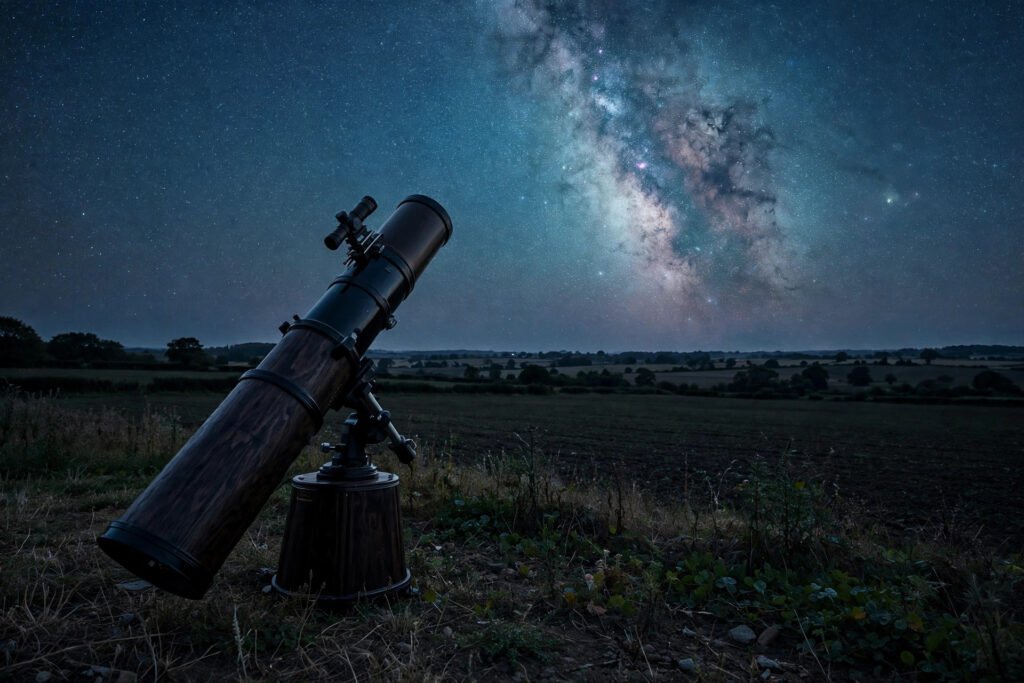
Britain’s dark skies are a treasure — from Northumberland’s gold-tier reserves to the Scottish Highlands, some of Europe’s darkest skies sit within a few hours’ drive. And 2026 is a fine time to start stargazing: Jupiter and Saturn put on good shows, meteor showers punctuate the year, and a decent beginner telescope costs less than a games console. But the market is full of shiny disappointments — wobbly tripods, useless magnification claims, telescopes that gather dust. Here are the best beginner telescopes for UK stargazers, and how to choose without wasting money.
What actually matters (and what does not)
Forget magnification — the number plastered on the box. What matters is aperture: the diameter of the main mirror or lens, which determines how much light the telescope gathers and therefore what you can see. A 130mm reflector massively outperforms a 60mm refractor advertising “675x magnification”, because high magnification on a tiny aperture just makes a bigger blur. Second is the mount: a shaky mount ruins everything, and most cheap-telescope misery comes from wobbly tripods, not bad optics. Third is simplicity — your first telescope should be usable within minutes, because a complicated setup kills enthusiasm fast.
The best types for beginners
Dobsonians: the most telescope per pound
A Dobsonian is a simple Newtonian reflector on a basic up-down, left-right mount — no fancy electronics, just a big mirror for the money. A 150mm (6-inch) Dobsonian, typically £250–£350, shows Saturn’s rings, Jupiter’s cloud belts and moons, hundreds of deep-sky objects, and the Moon in staggering detail. The 200mm (8-inch) versions (£350–£500) are the classic “lifetime” beginner scope. Downsides: they are bulky, and finding objects means learning the sky — which many consider a feature, not a bug. For pure value, nothing beats them.
Tabletop Dobsonians: the easy start
Small tabletop Dobsonians (76–130mm, £80–£180) sit on a sturdy table or wall and offer genuine astronomy at minimal cost and fuss. The 130mm models show real detail on planets and bright deep-sky objects. They are the perfect “is this hobby for me?” instrument — cheap enough to be low-risk, good enough to be genuinely rewarding. Pair with a stable surface and you are observing in minutes.
Computerised (GoTo) scopes: push-button astronomy
GoTo telescopes align themselves and slew to 40,000+ objects at the touch of a button — superb for light-polluted skies where star-hopping is hard. Expect £350+ for worthwhile models; cheaper GoTo scopes cut corners on optics and mounts. They are brilliant for impatient beginners and urban observers, though purists argue you learn the sky slower. For many, the trade-off is worth it.
What to avoid
Department-store refractors on spindly tripods advertising absurd magnification — the classic dust-gatherers. Bird-Jones “short tube” reflectors with corrective lenses (often sold as 1000mm+ in tiny tubes) have poor optics. Anything with a shaky mount, whatever the optics. And do not buy a telescope for astrophotography as a beginner — visual observing and photography are different hobbies with different equipment; master the sky first.
Essential accessories
Budget for: two or three decent eyepieces (low, medium and high power — often the supplied ones are the weakest link), a red-light torch (preserves night vision), a planisphere or stargazing app, and warm clothes — observers get cold standing still. A moon filter helps with lunar brightness. That is genuinely it; resist the accessory avalanche until you know what you need. And choose your observing site well — dark skies transform any telescope, which is why stargazers travel to places like the Lake District, where dark skies and dramatic landscapes combine, or time trips around the best month for Iceland’s northern lights for the ultimate night-sky holiday.
Where to buy and what to pay
Buy from specialist astronomy retailers, not general marketplaces — the advice alone is worth it, and they stock the reputable brands (Sky-Watcher, Celestron, Bresser, StellaLyra). Second-hand Dobsonians are excellent value; mirrors do not wear out and there is an active used market. Expect £150–£300 for a satisfying first scope, £350–£500 for a serious one. Join a local astronomical society before buying if you can — members love showing off their scopes, and trying before buying is invaluable. The Royal Observatory Greenwich’s astronomy resources and BBC Sky at Night Magazine’s telescope buying guides are the trusted references.
Binoculars first? The case for starting smaller
Here is the contrarian advice many experienced observers give: buy binoculars before a telescope. A decent pair of 10×50 binoculars (£60–£120) shows the Moon’s craters, Jupiter’s four largest moons, star clusters like the Pleiades, and sweeping views of the Milky Way — genuinely thrilling sights, with zero setup and a learning curve of minutes. They teach you the sky: finding constellations, star-hopping, understanding what you are looking at.
Binoculars also answer the crucial question — will you actually go outside on cold nights? — for £80 instead of £300. If the binoculars gather dust, you have saved money; if you use them constantly for six months, you have proven the hobby and learned the sky, making your eventual telescope purchase far smarter. Many lifelong observers keep binoculars alongside their biggest scopes; they are not a lesser instrument but a different one — wide-field, instant, intimate. The telescope can wait. The sky cannot, and it looks magnificent through £80 of glass. Whatever you buy, remember the best telescope is the one you actually use — a modest scope under dark skies outperforms a giant gathering dust in the garage.
Conclusion
The best beginner telescope for UK skies is the biggest aperture on the steadiest mount you can afford and will actually carry outside — usually a Dobsonian between 130mm and 200mm. Ignore magnification claims, prioritise the mount, buy from specialists, and get under dark skies. The universe is waiting; it has been waiting 13.8 billion years, so it can wait the ten minutes your telescope takes to cool down.
Frequently Asked Questions
How much should I spend on a first telescope?
£150–£300 buys a genuinely satisfying beginner scope (often a tabletop or 130mm Dobsonian); £350–£500 gets a serious 150–200mm instrument that can last years. Below £100, binoculars usually beat telescopes.
What is the best telescope for a beginner in the UK?
A Dobsonian reflector (130–200mm) offers the most aperture per pound on a simple, stable mount. Tabletop Dobsonians are the easiest start; GoTo models suit light-polluted skies.
Is magnification important?
No — it is the most misleading number in the hobby. Aperture (light-gathering) and mount stability matter far more. High magnification on a small, shaky scope just makes a bigger blur.
Can I see planets with a beginner telescope?
Yes — even a 130mm scope shows Saturn’s rings, Jupiter’s moons and cloud belts, and the Moon in spectacular detail. Bright nebulae, galaxies and star clusters are visible too under dark skies.
Should I buy a GoTo telescope as a beginner?
They are excellent for urban observers and the impatient, finding thousands of objects automatically. The trade-off is cost and slower sky-learning. Avoid cheap GoTo models with poor optics.
How much should a beginner spend on a first telescope?
£150–£350 buys a genuinely capable starter scope — enough to show Saturn’s rings and the Moon in stunning detail. Spending less usually buys frustration; spending more buys capability you cannot yet use. Upgrade when you know what you are missing.
Can you see planets from light-polluted cities?
Yes — planets punch through light pollution far better than deep-sky objects. The Moon, Jupiter and Saturn are excellent urban targets; save galaxies and nebulae for darker skies.