What Happens to Your Body in Space? The Full Honest Picture
What happens to your body in space? From bone loss to puffy faces, the real physiological changes astronauts endure and how scientists counteract them.
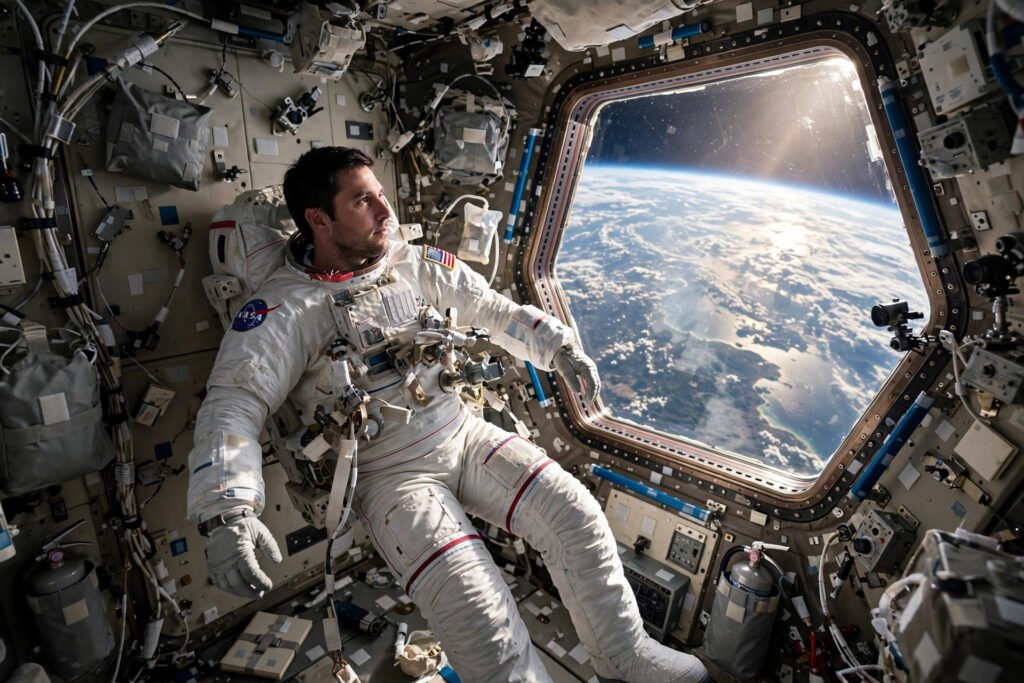
Step off Earth and your body begins to fall apart in slow motion. Without gravity’s constant pull, bones thin, muscles wither, fluids shift toward your head, and your immune system gets confused. Astronauts return from long missions measurably changed: taller, weaker, puffy-faced, and with eyes that may never fully recover. Space is the most hostile environment humans have ever inhabited, and the human body was not designed for it.
Yet we go anyway, and scientists have learned to fight back with exercise, diet, and clever engineering. This is the full picture of what microgravity does to the body, and how astronauts survive it.
The First Hours: Space Adaptation Syndrome
Within hours of reaching orbit, around half of astronauts develop space adaptation syndrome: nausea, vomiting, dizziness, and disorientation. The cause is a sensory conflict: the inner ear’s balance organs, which evolved to detect gravity, suddenly report nonsense, while the eyes insist everything is fine. The brain, receiving contradictory signals, concludes you have been poisoned and tries to expel the imaginary toxin.
Most crews adapt within 72 hours as the brain recalibrates, learning to rely on vision over vestibular input. It is the same mechanism behind seasickness and VR nausea, just in the most extreme possible setting.
Fluid Shift: The Puffy Face and Bird Legs
On Earth, gravity pools blood and fluid in your legs. In microgravity, roughly two litres of fluid migrate upward, producing the classic astronaut look: puffy face, congested sinuses, and thin “bird legs”. The stuffy-head feeling persists for weeks, dulling taste and smell, which is why astronauts crave strong flavours like hot sauce.
More seriously, the body interprets the headward fluid shift as excess blood volume and responds by reducing plasma, so total blood volume drops by up to twenty percent. On return to Earth, this causes the dizziness and fainting many astronauts experience: there is literally less blood to pump uphill. The cardiovascular system also deconditions; the heart, no longer pumping against gravity, shrinks slightly and weakens.
Bones and Muscles Waste Away
This is the headline risk of long missions. Without gravity loading the skeleton, bones lose density at one to two percent per month, ten times faster than severe osteoporosis on Earth. The spine, hips, and legs are hit hardest. Muscles atrophy similarly, particularly the postural muscles of the back, neck, and calves that work constantly against gravity without us noticing.
The countermeasure is brutal exercise: astronauts on the International Space Station train for two and a half hours daily, using resistive devices that simulate weightlifting, treadmills with bungee harnesses, and cycle ergometers. Even so, recovery on Earth takes months. Nutrition matters too: adequate protein, calcium, and vitamin D slow the losses, which is why space agencies obsess over crew diet with the same seriousness as supporting gut health with everyday foods matters on the ground.
Vision Changes: A Genuine Mystery
One of the most concerning discoveries of recent decades is Spaceflight Associated Neuro-ocular Syndrome: the upward fluid shift raises pressure inside the skull, flattening the back of the eyeball and swelling the optic nerve. Many long-duration astronauts return with permanently altered vision, some needing glasses for the first time. The mechanism is still not fully understood, and solving it is considered essential before any Mars mission.
Immunity, Sleep, and the Microbiome
Microgravity suppresses immune function: T-cells become less responsive, latent viruses like herpes reactivate, and wounds heal more slowly. Simultaneously, bacteria become more virulent in space, a genuinely alarming combination. Sleep suffers too: the station orbits Earth every 90 minutes, meaning sixteen sunrises a day, and the noise, schedule, and floating discomfort fragment rest. Crews use eye masks, earplugs, and carefully timed light exposure to impose a rhythm.
The gut microbiome also shifts in composition, with potential consequences for digestion and immunity that researchers are still mapping. BBC space science coverage regularly reports on these unfolding findings.
Radiation: The Invisible Danger
Outside Earth’s magnetic field, astronauts face cosmic radiation and solar particle events that damage DNA and raise cancer risk. The ISS sits partly protected within the magnetosphere; a Mars transit would not. Shielding is heavy and expensive, storm shelters are a partial answer, and this remains arguably the hardest problem in human spaceflight. The Royal Society’s space research publications cover the ongoing science in depth.
Why Bodies Bounce Back (Mostly)
The remarkable thing is how much recovers. Bones remineralise over months, muscles rebuild with training, blood volume normalises within weeks, and the vestibular system readapts to gravity in days. Astronauts are selected for resilience and monitored obsessively, which helps. The changes that worry doctors most are the potentially permanent ones: vision alterations and the cumulative radiation dose, both active research frontiers as missions get longer.
Understanding these effects is not just academic: the countermeasures developed for astronauts, from resistive exercise protocols to bone-density nutrition, increasingly inform treatment of bedridden patients and the elderly on Earth. Space medicine keeps paying dividends at home, much as AI is changing the way NHS doctors work by translating cutting-edge research into everyday care.
What We Still Do Not Know
For all the research, major questions remain open. Nobody knows the full cumulative effect of multi-year missions, because nobody has flown one; the vision changes are still only partly understood, with competing theories about fluid pressure, nutrition, and genetics. The microbiome shifts observed in orbit need years of follow-up to interpret. Radiation risk models for deep space rely on extrapolations that could be significantly wrong in either direction. And the biggest unknown of all is partial gravity: we have abundant data on zero gravity and full Earth gravity, but almost nothing on the one-third gravity of Mars or one-sixth of the Moon, where humans may one day live permanently. Each long mission is simultaneously an exploration and an experiment, with the crew as both researchers and subjects. The answers will come, but slowly, one mission at a time.
Conclusion
In space, your face swells, your bones thin, your muscles waste, your vision blurs, and your immune system falters, yet with two and a half hours of daily exercise, careful nutrition, and clever engineering, humans endure it for a year at a time and mostly recover. The body is astonishingly adaptable, even to the absence of the force that shaped its entire evolution. As missions stretch toward Mars, learning to protect it better is one of the great scientific challenges of our time.
Frequently Asked Questions
Do astronauts grow taller in space?
Yes, by three to five centimetres, as the spine decompresses without gravity. The effect reverses within days of returning to Earth, sometimes painfully.
How do astronauts exercise in zero gravity?
With specialised equipment: a resistive exercise device simulating weightlifting, a treadmill with bungee harnesses holding them down, and a cycle ergometer. They train about two and a half hours every day.
Can the human body survive permanently in space?
Unknown. The longest single mission is just over a year, and cumulative effects like bone loss, vision changes, and radiation exposure are serious concerns for multi-year missions such as Mars.
Why do astronauts lose their sense of taste?
Fluid shifting to the head causes persistent nasal congestion, dulling smell and therefore taste. Astronauts compensate with strongly flavoured foods and condiments.