What to Include in Your Car’s Emergency Kit UK
what to include in your car’s emergency kit UK: the essentials every driver should carry, seasonal additions, family extras and smart motorway survival.
Breakdowns don’t schedule themselves. The AA attends hundreds of thousands of callouts yearly, and a striking proportion stem from problems a basic emergency kit would have mitigated — flat batteries in winter, punctures on smart motorways, overheating in summer queues. A well-stocked emergency kit won’t prevent every breakdown, but it transforms a crisis into an inconvenience. Here’s what British drivers should actually carry, and why.
The Legal Requirements (Fewer Than You Think)
Unlike France or Spain, the UK mandates almost nothing — no legal requirement for warning triangles, hi-vis vests or first aid kits. But “not legally required” isn’t “not needed,” and the moment you drive abroad the rules change. Our guide to driving in France covers the kit that’s compulsory across the Channel — much of which is worth carrying at home too.
The Essentials: What Every Car Should Carry
1. Warning triangle
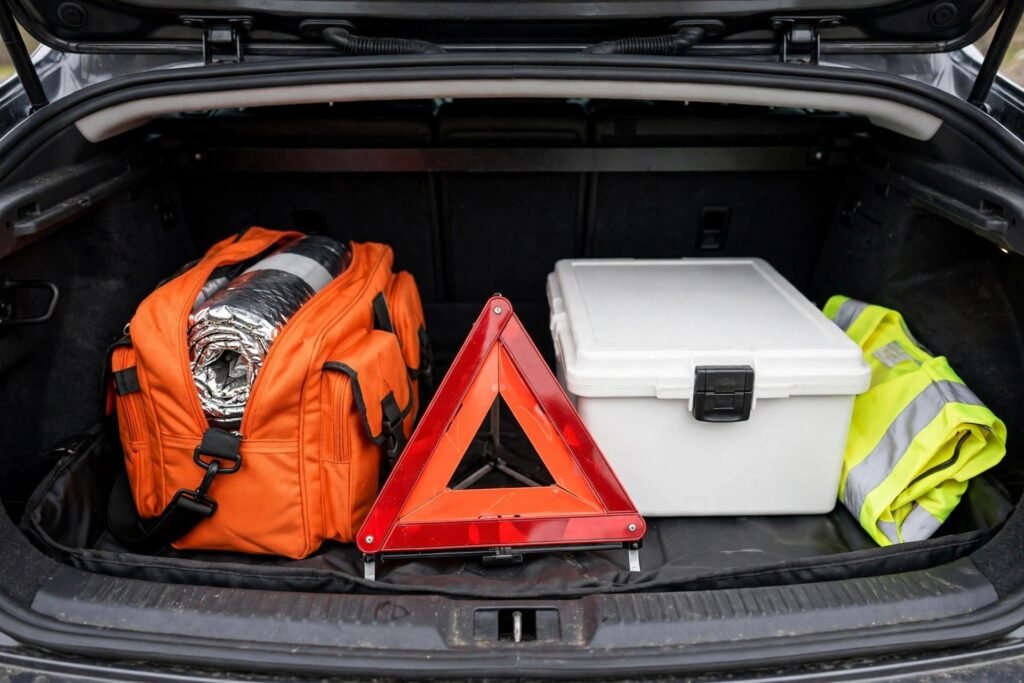
£10–£15, folds flat, lives in the boot. On motorways and dual carriageways, place it 45 metres behind your vehicle (never on the carriageway itself — use the hard shoulder or verge). It gives approaching drivers critical warning, especially at night or in poor visibility. The Highway Code recommends one; common sense demands it.
2. Hi-vis vest (one per occupant)
If you break down on a smart motorway at night, a hi-vis vest is the difference between being seen and being a statistic. Keep them in the cabin, not the boot — you need to put one on before exiting the vehicle. £3 each; buy for every regular passenger.
3. First aid kit
A proper kit — not the dusty 1998 relic in your glovebox. Should include: assorted plasters, sterile dressings, bandages, antiseptic wipes, medical tape, scissors, tweezers, disposable gloves, a foil blanket and a first aid guide. Check expiry dates annually; sterile items degrade. The British Red Cross sells suitable kits and offers free first aid learning resources — knowing how to use the kit matters more than owning it.
4. Torch (and spare batteries)
Breakdowns love darkness. A wind-up or USB-rechargeable torch avoids the dead-battery problem of traditional ones. Your phone torch works in a pinch but drains the battery you might need for calling recovery.
5. Jump leads or jump-start pack
Flat batteries are the number one winter breakdown cause. Jump leads (£15–£25) require a donor vehicle and correct connection sequence (a sequence worth learning before you need it). A lithium jump-start pack (£50–£80) works solo and doubles as a phone charger — the better option for most drivers. Keep it charged; check quarterly.
6. Tyre repair: spare, sealant or compressor
Know which your car has. Many modern cars omit spare wheels for weight/emissions, providing sealant kits instead — which only work for tread punctures, not sidewall damage or blowouts. A 12V tyre compressor (£25–£40) plus sealant handles most slow punctures well enough to reach a garage. If you have a spacesaver spare, check its pressure annually (they’re always flat when needed) and know where your jack and locking wheel nut key live.
The Seasonal Additions
Winter: blanket or sleeping bag (if you’re stranded overnight, warmth is survival), warm spare clothing, bottled water, snacks (cereal bars — check dates), a shovel (rural drivers), de-icer and scraper, and a phone power bank. Winter breakdowns on remote roads can mean hours waiting for recovery; comfort items aren’t luxuries.
Summer: extra water (for you and an overheating engine — never open a hot radiator cap), sunshade, and sunscreen. Summer motorway queues in a dead car become greenhouses fast, especially with children or pets aboard.
For Families: The Extra Layer
Travelling with children transforms breakdown priorities. Add: nappies/wipes if relevant, children’s snacks and water, entertainment (a charged tablet), any essential medication, and warm layers for everyone. A breakdown that’s merely boring for adults is distressing for small children — preparation prevents the spiral. Check child car seat rules on GOV.UK too — if recovery transports you in another vehicle, your seats need to transfer.
Smart Motorway Survival: Know the Drill
Smart motorways (no hard shoulder) change breakdown procedure: try to reach an emergency refuge area (the orange-surfaced laybys, now more frequent after safety reviews). If you can’t, stay in the vehicle with seatbelts on and hazard lights flashing if it’s unsafe to exit — National Highways guidance prioritises staying put over crossing live lanes. Your hi-vis vest and warning triangle matter most in exactly this scenario. Keep your breakdown provider’s number saved in your phone, not just in the policy documents at home.
Maintenance: The Kit Is Useless If Neglected
An emergency kit needs annual auditing: check first aid expiry dates, torch batteries, jump-pack charge, tyre sealant dates, water bottles, snack dates and blanket condition. Tie it to your MOT — booked via GOV.UK guidance — as a yearly reminder. A kit you can’t trust is decoration.
Storing the Kit: Organisation Matters
A kit scattered loose around the boot is a kit you can’t find in the dark, in the rain, on a motorway shoulder. Organise it: a dedicated boot organiser or bag (£15–£30) keeps everything together and stops items migrating; keep the hi-vis vests in the cabin (door pockets or under seats — you need them before you exit, not after opening the boot on a live carriageway); store the warning triangle somewhere accessible (not buried under luggage); and keep a laminated emergency card in the glovebox with your breakdown provider’s number, your policy number, and the number for emergency services. Tell regular passengers where the kit lives — in a genuine emergency, a passenger who knows where the first aid kit is matters more than the kit itself. The best-organised kit is the one everyone in the car can locate without thinking.
The Bottom Line
The complete kit — triangle, hi-vis vests, first aid, torch, jump-start pack, tyre repair, plus seasonal additions — costs under £150 and fits in a corner of the boot. Against the cost, stress and potential danger of an unprepared breakdown, it’s the best-value motoring purchase you’ll make. Build it once, audit it yearly, and drive knowing that whatever the road throws at you, you’re ready. For diagnosing problems before they become emergencies, see our guide to AI car diagnostics.
Frequently Asked Questions
Is it illegal to drive without a warning triangle in the UK?
No — unlike many European countries, the UK doesn’t legally require warning triangles, hi-vis vests or first aid kits. But they’re strongly recommended by the Highway Code and motoring organisations, and they’re compulsory in several countries British drivers commonly visit.
Should I get breakdown cover as well as a kit?
Yes — the kit handles minor issues; breakdown cover handles everything else. Compare providers on response times and coverage limits, not just price. The cheapest cover often means the longest waits. Bank accounts and car insurance sometimes include breakdown cover — check before buying separately.
How do I use jump leads safely?
Connect positive-to-positive, then the donor’s negative to an unpainted metal earth point on the dead car (not its negative terminal) — this avoids sparks near the battery. Start the donor car, wait a few minutes, then start the dead car. Disconnect in reverse order. If you’re unsure, a lithium jump pack is simpler and safer.
What should I do if I break down on a smart motorway?
Try to reach an emergency refuge area. If impossible, pull as far left as possible, hazards on, and if you can exit safely (left side, behind the barrier), do so and call for help. If exiting means crossing live traffic, stay in the vehicle with seatbelts fastened and call emergency services on 999 if you feel in immediate danger.