Why Do Onions Make You Cry? The Chemistry Explained
Why do onions make you cry: the chemistry of syn-propanethial-S-oxide, plus proven tricks to chop onions tear-free — from chilling them to using sharp knives.
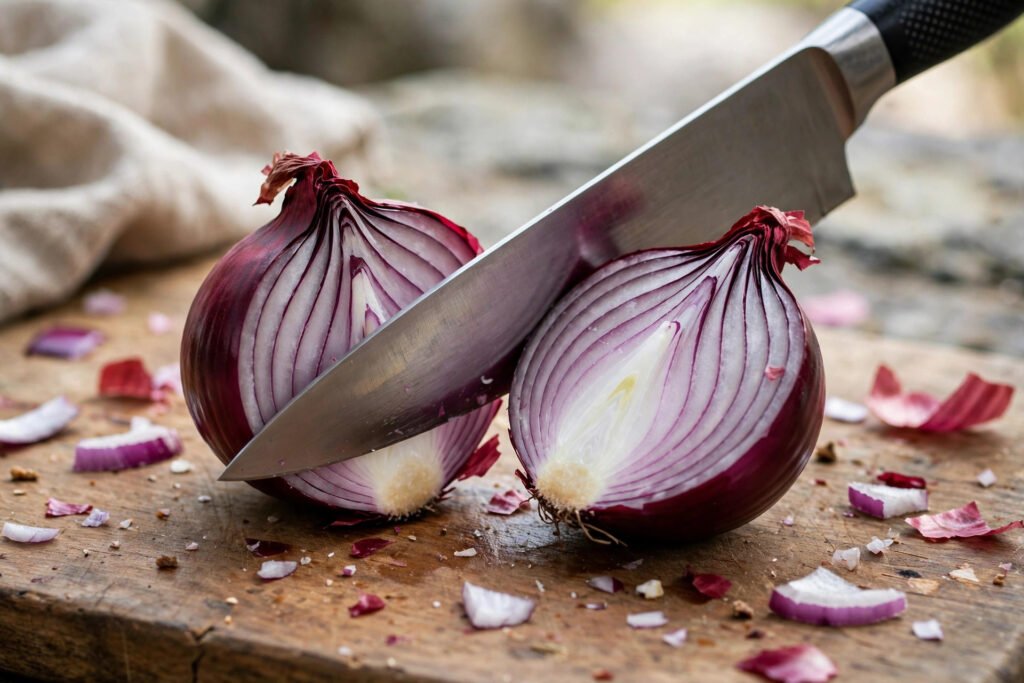
Chopping onions makes almost everyone cry — and it is not emotion, it is chemical warfare. Onions have evolved an elaborate defence system that, when you slice into them, manufactures a volatile irritant specifically designed to make animals’ eyes stream. It is one of the plant kingdom’s most sophisticated booby traps, and food scientists have mapped it in exquisite detail. Here is the chemistry of why onions make you cry, and what actually helps.
The onion’s defence system: three parts, one trigger
An intact onion keeps its chemical weapons disassembled for safety — like a bomb stored in separate parts. Sulphur compounds sit in the cell fluid; enzymes called alliinases wait in separate compartments; and lachrymator-making enzymes lurk elsewhere. Slice the onion and you rupture thousands of cells, mixing the components. Within seconds, a cascade fires: sulphur compounds convert to sulphenic acids, and then lachrymatory factor synthase — the enzyme scientists identified as the final trigger in the early 2000s — converts them into syn-propanethial-S-oxide, a volatile gas that wafts upward. The Royal Society of Chemistry covered the enzyme discovery in detail, and BBC Science Focus explains food chemistry for curious cooks. Your eyes are simply downwind of a chemical reaction.
Why the gas makes you cry
Syn-propanethial-S-oxide dissolves in your tear film and stimulates the trigeminal nerve endings — the same nerves behind sneezing and the burn of chilli. Your brain interprets this as an attack and orders the lacrimal glands to flood the eyes, attempting to wash the irritant away. Tears are literally your eyes’ defence protocol working as designed. The effect is entirely temporary and harmless — the compound breaks down quickly — but in the moment it is miserable. Interestingly, cooking destroys the enzymes, which is why cooked onions never make anyone cry; heat denatures lachrymatory factor synthase before it can act.
Why some onions are worse than others
Sulphur content varies enormously. Pungent yellow and red onions, grown in sulphur-rich soils, pack the most ammunition; sweet onions (Vidalia, Walla Walla) contain far less sulphur and correspondingly fewer tears. Fresh, firm onions are more potent than old, sprouting ones whose chemistry has degraded. And the root end concentrates the worst of it — the basal plate holds the highest enzyme levels, so save it for last or cut it off first and discard it. Professional chefs mostly just accept a few tears as the cost of doing business.
What actually works (and what does not)
Tested against the chemistry, most folk remedies fail. Holding bread in your mouth, lighting candles, or chewing gum have no plausible mechanism and perform no better than placebo in informal tests. What works: chilling the onion for 30 minutes before cutting (cold slows the enzymes dramatically); cutting under running water or beside a fan (the gas is swept away before reaching your eyes); using a very sharp knife (clean cuts rupture fewer cells than crushing cuts — a dull knife is a tear factory); and wearing sealed goggles or contact lenses (a physical barrier the gas cannot cross). Onion goggles look absurd and work brilliantly — laboratory suppliers sell them because lab workers face the same chemistry. Leaving the root end intact until the end also measurably helps.
The same sulphur chemistry that assaults your eyes is also what gives onions their flavour — the compounds that make you cry are cousins of the ones that make onions delicious when cooked. It is worth appreciating the elegance: one enzyme cascade, two outcomes, depending on heat. Put the knowledge to delicious use in restaurant-style curry at home, where properly softened onions build the entire flavour base. Kitchen chemistry is full of such dualities, from the fermentation in sourdough to the browning of a proper roast.
The tearless onion: science’s answer
In a delightful twist, scientists have used the enzyme discovery to breed and engineer tearless onions. Japanese researchers developed the “Smile Ball” onion by suppressing lachrymatory factor synthase, and gene-edited versions are in development. They taste slightly different — inevitably, since the tear compounds contribute to flavour — but for the tear-prone cook they are a genuine marvel. Until they reach your supermarket, the freezer and a sharp knife remain your best friends.
Onion varieties and their chemistry: a cook’s guide
Not all onions are chemically equal, and choosing the right one is applied chemistry. Yellow onions: the all-rounders, high in sulphur compounds, pungent raw but sweet and complex when cooked — the sulphur chemistry that makes you cry transforms into deep flavour with heat. Red onions: milder, beautiful raw in salads where their colour shines. White onions: sharper, cleaner flavour, the choice for Mexican and fresh salsas. Sweet onions (Vidalia, Walla Walla): low sulphur, minimal tears, genuinely sweet — bred for low pungency, which is why they barely sting.
Shallots: milder and more refined than onions, with a hint of garlic — the chef’s choice for vinaigrettes. Spring onions and leeks: the same family, progressively milder, with the tear chemistry concentrated in the bulb. Storage affects chemistry too: cold-stored onions are milder (and, as noted, chill before cutting for fewer tears), while sprouting onions develop bitter green shoots — still usable, but the chemistry has shifted. The cook’s rule of thumb: the more pungent raw, the more flavourful cooked. Tears are the price of depth — and now you know exactly what you are paying for. And a final kitchen tip: the sharper your knife, the fewer tears. Professional chefs cry less not because they are tougher, but because sharp blades rupture fewer cells. Keep your knives honed and your eyes will thank you daily.
Conclusion
Onions make you cry because slicing mixes separated chemicals into syn-propanethial-S-oxide, a volatile lachrymator that triggers your eyes’ flood defences. Chill the onion, use a sharp knife, ventilate the gas away, or wear goggles — and take comfort that the same chemistry makes onions taste so good. It is not suffering; it is biochemistry.
Frequently Asked Questions
What chemical in onions makes you cry?
Syn-propanethial-S-oxide, a volatile gas produced when slicing mixes the onion’s sulphur compounds with enzymes, finalised by lachrymatory factor synthase. It stimulates tear production via the trigeminal nerve.
Does chilling onions really stop tears?
Yes — refrigerating for 30 minutes measurably reduces tearing because cold slows the enzymes that produce the irritant gas. It is one of the few remedies with a real chemical mechanism.
Why do sweet onions make you cry less?
Sweet onion varieties contain less sulphur, so they produce less of the lachrymator precursor compounds. Less ammunition, fewer tears.
Do onion goggles actually work?
Yes — they are one of the most effective solutions because they physically block the gas from reaching your eyes. They look silly and work brilliantly.
Are tearless onions available to buy?
Tearless varieties like Japan’s “Smile Ball” exist and gene-edited versions are in development, but they are not yet widely available in UK supermarkets. They taste slightly milder than conventional onions.
Do red onions make you cry less than yellow ones?
Slightly — red onions are generally milder with a little less sulphur, but the difference is modest. Sweet onions are the real low-tear option; the colour matters less than the variety’s sulphur content.
Why do my eyes water more with old onions?
Actually fresh, firm onions are usually more potent — their enzyme systems are intact. Old, sprouting onions have degraded chemistry and often produce fewer tears, though they taste worse too.