
What Happens to Crypto When the Bank of England Cuts Rates?
What happens to crypto when the Bank of England cuts rates? Liquidity, sterling effects and the inflation narrative — plus why you shouldn’t trade the MPC.
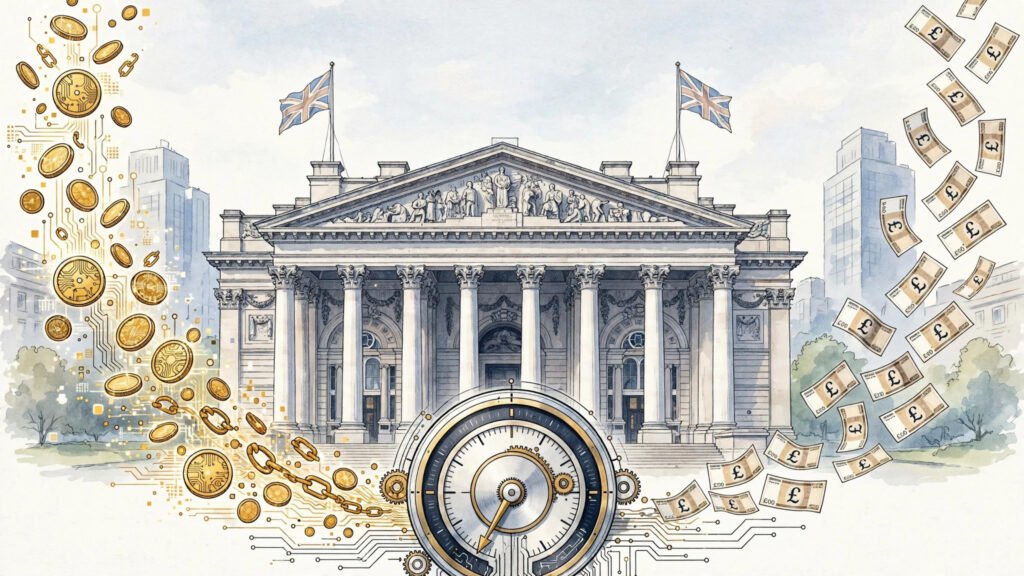
When the Bank of England cuts interest rates, the headlines talk about mortgages and savings accounts. But in the corner of the market, crypto traders watch the Monetary Policy Committee just as anxiously — because rate cuts move Bitcoin’s price through channels that are powerful, indirect and widely misunderstood. If you hold crypto in the UK, understanding this relationship is the difference between reacting to headlines and understanding them.
This guide explains what actually happens to crypto when the Bank cuts rates: the transmission mechanisms, what history shows, why the effect is unreliable, and how UK investors should think about it.
Channel 1: liquidity and risk appetite
The primary channel is simple: lower rates mean cheaper money, and cheaper money flows toward risk. When the Bank cuts Bank Rate, borrowing costs fall across the economy, bond yields drop, and the return on “safe” assets shrinks — pushing investors outward along the risk curve: from gilts to corporate bonds to equities to crypto. Bitcoin, as the highest-beta mainstream asset, tends to benefit disproportionately from this tide. This is why crypto rallied powerfully during the near-zero-rate era and suffered when rates rose sharply in 2022–2023.
But “tends to” does heavy lifting. The relationship is strongest at extremes and mushiest in the middle: a cut from 5.25% to 5% changes little about global liquidity; a cutting cycle from 5% toward 2% changes a lot. What matters is the direction and expected path of rates, not any single decision — markets price the trajectory. A “hawkish cut” (rates down, but the Bank signalling no more cuts) can actually disappoint risk assets. Watch the Monetary Policy Report and the vote split, not just the headline number, on bankofengland.co.uk.
Channel 2: the pound, the dollar and Bitcoin’s pricing
Here’s the channel UK investors miss: Bitcoin is priced globally in dollars. When the Bank of England cuts rates, sterling typically weakens against the dollar (lower UK yields make pounds less attractive to hold). A weaker pound means the sterling price of Bitcoin rises even if the dollar price is flat — UK holders see gains that have nothing to do with crypto fundamentals and everything to do with currency.
This cuts both ways: Bank hikes strengthen sterling and depress the pound-price of Bitcoin. So a UK investor’s returns are always a blend of Bitcoin’s dollar performance and GBP/USD moves — two volatile series multiplied together. Over long holding periods this currency effect roughly washes out, but over months it can dominate. If you’re comparing your portfolio to dollar-denominated headlines (“Bitcoin hits $100k!”), convert properly before celebrating or despairing — your sterling reality may differ significantly.
Channel 3: inflation expectations and the “digital gold” narrative
Rate cuts often signal (or stoke) inflation concerns: cheaper money, more spending, rising prices. Bitcoin’s “digital gold” narrative — a fixed-supply asset that holds value as currencies debase — gets louder whenever inflation expectations rise. In theory, anticipated inflation should bid up scarce assets including Bitcoin. In practice, Bitcoin has behaved more like a tech stock than digital gold in recent cycles: it sold off with growth equities when inflation spiked in 2022, behaving as a risk asset rather than a hedge.
The honest assessment: Bitcoin’s inflation-hedge properties are unproven over the relevant timescales — it hasn’t existed through a full 1970s-style inflationary decade. Treat the narrative as marketing until the data says otherwise. What rate cuts reliably do is boost nominal asset prices broadly; whether Bitcoin captures more than its share depends on sentiment, positioning and the crypto-specific cycle — halvings, ETF flows, regulatory news — which frequently overpower macro.
What history actually shows
The empirical record is mixed enough to humble everyone. Crypto’s biggest bull runs coincided with easy money (2020–2021), and its worst drawdown coincided with aggressive hiking (2022) — supporting the liquidity story. But crypto has also rallied into hikes and sold off into cuts when crypto-specific factors dominated: exchange collapses, regulatory crackdowns and ETF launches have all moved prices more than any MPC decision. Correlation is not causation, and the sample size (barely 15 years, mostly in unusual monetary conditions) is thin.
The practical takeaway for UK holders: rate cuts are a tailwind, not a trigger. They improve the background conditions for risk assets, but they don’t predict crypto prices with anything like tradeable reliability. Anyone selling you a strategy of “buy Bitcoin before every MPC meeting” is selling astrology. Far more important for your returns: your entry valuation, position size, security practices, and tax efficiency — the unglamorous fundamentals. On the security front, securing your home network matters more to your wealth than any rate decision.
How UK investors should position
Don’t trade the MPC — invest through the cycle. If you believe rates are entering a sustained cutting phase, the sensible interpretation is: background conditions for risk assets are improving, which supports maintaining (not increasing) a disciplined crypto allocation. The wrong interpretation is leveraging up ahead of a cut announcement. Position sizing should reflect crypto’s volatility, not your macro forecast — even professional macro traders get the direction right barely more than half the time. Be equally sceptical of the risks of AI-driven financial advice when algorithms opine on macro.
Use rate-cut periods productively: they’re often good moments to review and rebalance — trim positions that grew beyond your target allocation, harvest losses or gains tax-efficiently within your £3,000 CGT allowance, and check your security setup. And keep the currency effect in mind when evaluating performance: measure your portfolio in pounds, against your own goals, not against dollar headlines. For the tax mechanics of acting on any of this, HMRC’s cryptoassets guidance is the reference.
Conclusion
When the Bank of England cuts rates, crypto gets a tailwind through cheaper money and higher risk appetite, a currency kicker through sterling weakness, and a narrative boost from inflation talk — but none of it is reliable enough to trade on, and crypto-specific forces routinely dominate. For UK investors, the MPC decision is background music, not the main act. Keep your allocation disciplined, your security tight, your tax records clean, and let the rate cycle do whatever it does while you focus on what you can actually control — because that discipline compounds, whatever the MPC decides.
Frequently Asked Questions
Do interest rate cuts make Bitcoin go up?
They tend to support risk assets including Bitcoin through cheaper money and higher risk appetite, but the effect is unreliable — crypto-specific factors often dominate, and cuts don’t guarantee price rises.
Why does the pound affect my Bitcoin’s value?
Bitcoin is priced globally in dollars. When rate cuts weaken sterling against the dollar, the pound-price of Bitcoin rises even if the dollar price is unchanged.
Is Bitcoin a good hedge against inflation?
Unproven — Bitcoin has behaved more like a tech stock than digital gold in recent inflation episodes. Treat the inflation-hedge narrative cautiously until longer data exists.
Should I buy crypto before a Bank of England rate decision?
No — trading MPC meetings is speculation, not strategy. Markets price expected decisions in advance, and surprises cut both ways. Invest to a plan, not to a calendar.
Where can I follow Bank of England decisions?
The Bank publishes decisions, minutes, vote splits and the Monetary Policy Report on bankofengland.co.uk — the vote split and forward guidance matter more than the headline rate.






