What Is the James Webb Telescope Discovering Now?
What is the James Webb telescope discovering now? The latest findings on exoplanets, early galaxies and cosmic mysteries — explained in plain English.
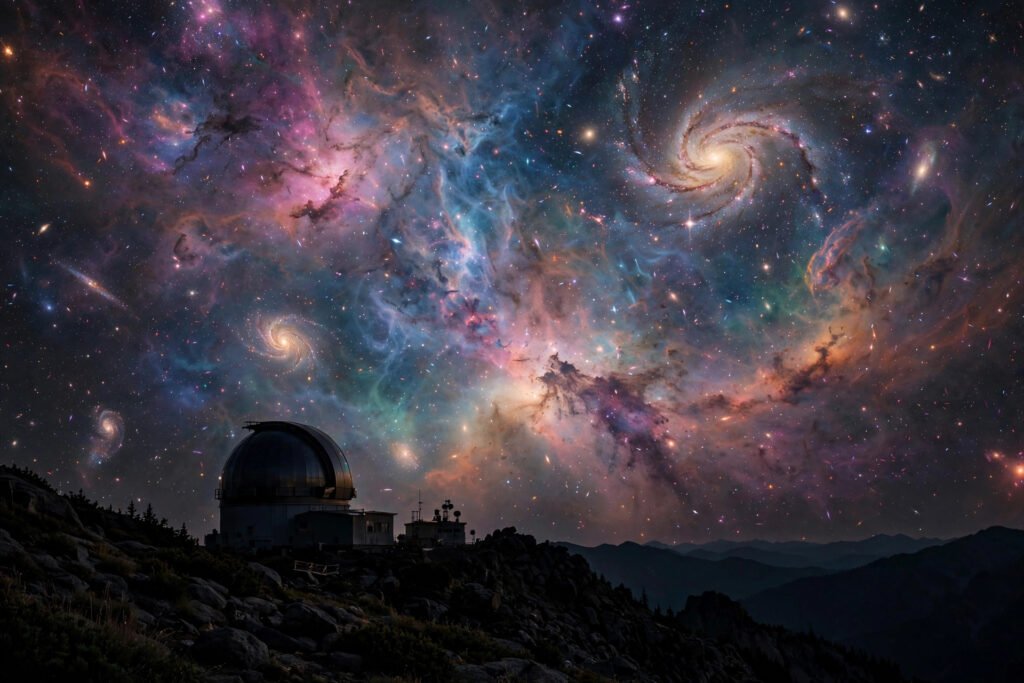
The James Webb Space Telescope is the most ambitious observatory ever built — a £7.5 billion, tennis-court-sized instrument parked a million miles from Earth, seeing the universe in infrared light. Since its first images in July 2022, it has rewritten textbooks at a pace astronomers can barely keep up with. But what is it discovering right now, in 2026? From the earliest galaxies to the atmospheres of alien worlds, here is where Webb’s science stands today.
Seeing the first galaxies — and a puzzle
Webb’s headline mission was to see the first stars and galaxies igniting after the Big Bang, and it has delivered beyond expectations — almost too far beyond. It keeps finding surprisingly large, bright, mature-looking galaxies existing just 300–500 million years after the Big Bang, earlier than standard cosmological models comfortably allow. These “impossibly early” galaxies have forced theorists back to the drawing board: either early star formation was far more efficient than thought, or our models of the infant universe need revision. Far from a crisis, astronomers call this the best kind of problem — data dragging theory forward. Follow-up spectroscopy campaigns through 2025 and 2026 have been confirming distances and refining the picture, and each observing cycle sharpens it further.
Reading the air of alien worlds
Webb’s most publicly thrilling work is exoplanet atmospheres. By watching starlight filter through a planet’s atmosphere during transit, Webb reads its chemical fingerprint. It has detected water vapour, carbon dioxide, methane and even signs of exotic clouds on worlds from hot Jupiters to rocky super-Earths. The standout targets are the TRAPPIST-1 system and K2-18b — a “Hycean” world where 2023–2025 observations found methane, carbon dioxide and a tentative hint of dimethyl sulphide, a molecule that on Earth is produced only by life. Scientists stress the detection is unconfirmed and abiotic explanations exist, but the mere fact we can have this conversation about a planet 124 light-years away shows how far the field has come. NASA’s Webb mission pages track each new atmospheric result as it is published.
Star birth and death in unprecedented detail
Webb’s infrared vision pierces the dust clouds that hide stellar nurseries, revealing star formation in sculptural detail — the Pillars of Creation re-imagined, protostars firing jets, and planetary systems visibly assembling. At the other end of stellar life, it has mapped supernova remnants and the chaotic environments around supermassive black holes, including the most distant quasars ever seen, shining when the universe was under a billion years old. These are not just pretty pictures; each image encodes physics about how the elements that make up planets — and people — were forged and distributed.
Our own solar system, up close
Between deep-field campaigns, Webb turns its gaze homeward with spectacular results: unprecedented views of Jupiter’s auroras, Saturn’s rings in ghostly infrared, Neptune’s crisp rings, and detailed studies of Mars, Europa and Enceladus — the icy moons whose subsurface oceans make them prime targets in the search for life. Webb has even tracked asteroids and characterised interstellar visitors. Its solar-system work reminds us that discovery is not only about the farthest reaches; our own neighbourhood still holds surprises.
What comes next
Webb is expected to operate for 20 years or more — its fuel reserves far exceeded requirements thanks to a flawless launch. Upcoming priorities include a full atmospheric census of rocky habitable-zone planets, deeper surveys of the cosmic dawn, and coordinated observations with ground-based giants like the Extremely Large Telescope. Each cycle’s proposals are fiercely competitive, with thousands of astronomers worldwide queuing for time. The European Space Agency’s ESA science portal covers Europe’s major role in the mission and upcoming observation campaigns.
For stargazers inspired to look up themselves, seeing the northern lights in the UK is the closest you will get to Webb-level wonder with the naked eye — and planning around the best month to visit Iceland for the northern lights takes that wonder to its spectacular extreme.
How Webb’s images are made: from data to those colours
Those spectacular Webb images are not photographs in the normal sense — they are translations. Webb’s instruments capture infrared light invisible to human eyes, recording data across multiple wavelength filters. Scientists then assign visible colours to each infrared wavelength (a process called chromatic ordering, usually blue for shortest wavelengths through red for longest) and combine them into the images we see. The colours are representative, not imaginary: they encode real physical information about temperature, composition and distance.
This is standard practice across astronomy — Hubble’s famous images are processed the same way — but it confuses some newcomers who assume the colours are “fake”. They are no more fake than a weather map’s colours: a visual encoding of real measurements. Raw Webb data is actually black-and-white per filter; the artistry lies in choosing colour mappings that reveal structure honestly. And the data is public: anyone can download observations from the archives and process their own images, which is why amateur processors regularly produce stunning alternative versions of famous targets. The universe provides the data; human choices provide the palette. For the full experience, explore the archives yourself: the Mikulski Archive for Space Telescopes hosts every Webb observation free, and the ESA’s ESASky portal lets you browse the sky in multiple wavelengths. You can literally inspect the same data the professionals use — citizen science at its finest.
Conclusion
Right now, the James Webb Space Telescope is rewriting the story of the early universe, sniffing the atmospheres of distant worlds for hints of life, and revealing star birth in breathtaking detail. Four years into its mission, it has already exceeded its design goals — and with decades of fuel remaining, the biggest discoveries may still be ahead.
Frequently Asked Questions
What is the James Webb Space Telescope’s biggest discovery so far?
The unexpectedly mature galaxies in the very early universe, which challenge models of cosmic dawn, alongside detailed exoplanet atmosphere measurements. Both have opened entirely new research directions.
Has Webb found signs of life on another planet?
Not confirmed. Hints of interesting molecules (like dimethyl sulphide on K2-18b) have been detected, but all have possible non-biological explanations. Webb is building the capability; confirmation will take years.
How is Webb different from Hubble?
Webb observes primarily in infrared with a mirror over six times Hubble’s area, letting it see the earliest galaxies and peer through dust. Hubble remains operating in visible and ultraviolet light — they complement each other.
How long will the Webb telescope last?
Designed for 10 years, it now carries fuel for 20+ thanks to an exceptionally accurate launch. Its instruments and orbit are healthy with no major issues reported.
Can I see Webb’s images anywhere?
Yes — NASA and ESA publish all major releases free online, and the raw data becomes public after a proprietary period, so anyone can explore the observations.
How far can Webb see?
Webb has detected galaxies whose light left them over 13.4 billion years ago — we see them as they were just 300–400 million years after the Big Bang. It is effectively a time machine pointed at the infant universe.
Will Webb be serviced like Hubble was?
No — Webb orbits a million miles away at Lagrange point 2, far beyond any servicing mission. It was designed to work without maintenance, with redundant systems and fuel for 20+ years.