What Is Dark Matter? Explained in Plain English
What is dark matter explained in plain English: the invisible stuff shaping galaxies, the key evidence supporting it, and what scientists still don’t know.
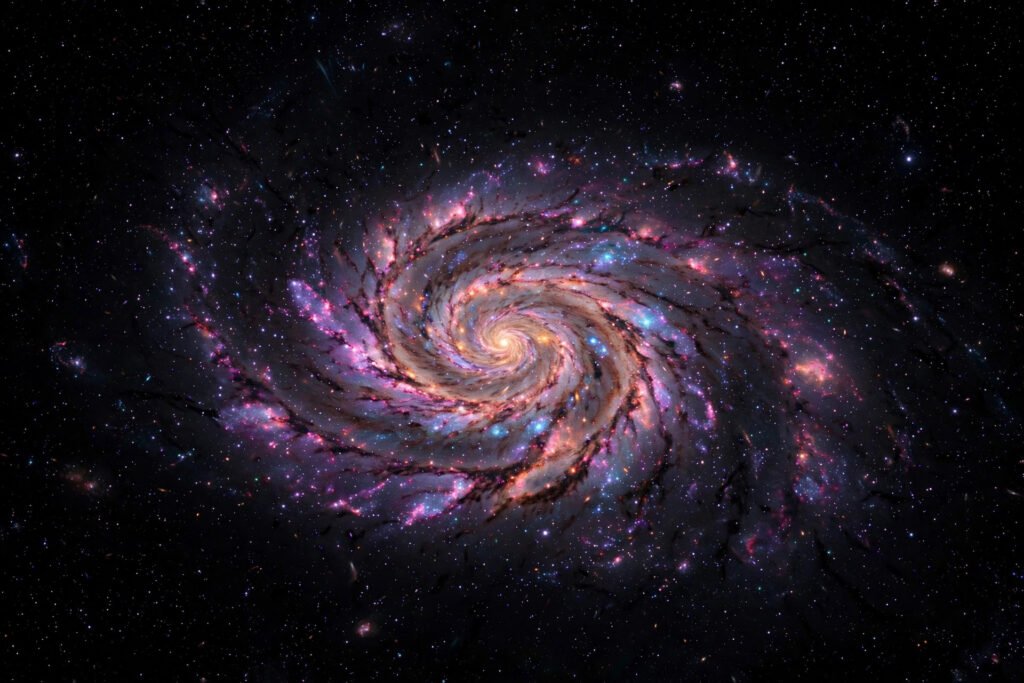
Everything you can see — stars, planets, galaxies, you — makes up less than five per cent of the universe. About 27 per cent is something else entirely: dark matter, an invisible substance whose gravity sculpts galaxies and bends light across the cosmos, but which has never been directly detected. It is the biggest unsolved mystery in modern physics. Here is what dark matter is, how we know it is there, and why it matters.
The evidence: galaxies that should fly apart
The story starts in the 1970s with astronomer Vera Rubin, who measured how fast stars orbit within spiral galaxies. The expectation: stars far from the galactic centre should orbit slowly, like distant planets orbit the sun slowly. The reality: outer stars orbit just as fast as inner ones. The only explanation is far more gravity than visible matter provides — galaxies are embedded in vast halos of invisible mass, roughly five times the mass of everything we can see. Without it, galaxies would spin themselves apart.
The evidence has piled up since. Galaxy clusters bend light from background objects (gravitational lensing) far more than their visible mass allows — we can literally map dark matter’s distribution by its lensing. The cosmic microwave background, the Big Bang’s afterglow, encodes the universe’s composition with exquisite precision: about 5 per cent ordinary matter, 27 per cent dark matter, 68 per cent dark energy. And computer simulations of cosmic structure only produce the universe we observe — the cosmic web of galaxies — when dark matter is included. Multiple independent lines of evidence converge on the same answer.
What could it be?
The leading candidate is WIMPs — Weakly Interacting Massive Particles, hypothetical particles that barely interact with ordinary matter except through gravity. Decades of exquisitely sensitive underground detectors have hunted WIMPs without a confirmed detection, progressively ruling out the most favoured models. Alternatives have risen: axions (ultralight particles that could also solve a puzzle in particle physics), sterile neutrinos, or primordial black holes formed in the Big Bang’s first moments. Each candidate predicts different experimental signatures, and the search spans mile-deep mines, space telescopes and particle colliders. The Science Museum Group and university outreach pages track these experiments for the curious.
The radical alternative: maybe gravity is wrong
A minority of physicists argue the problem is not missing matter but incomplete gravity. Modified Newtonian Dynamics (MOND) and its relativistic successors tweak gravity’s laws at galactic scales, reproducing Rubin’s rotation curves without any dark matter. MOND handles individual galaxies elegantly but struggles with galaxy clusters and the cosmic microwave background — observations dark matter explains naturally. Most cosmologists consider dark matter the far stronger hypothesis, but the debate keeps both sides honest. Either way — new matter or new gravity — the resolution will rewrite physics.
Why it matters beyond astronomy
Dark matter is not academic trivia: it determined the universe’s structure. In the early universe, dark matter’s gravity pulled ordinary matter into the filaments and knots that became galaxies, stars and planets — without it, the cosmos would be a smooth, starless fog and we would not exist. Discovering its nature would complete our picture of what the universe is made of and likely reveal new physics beyond the Standard Model — the kind of foundational shift that arrives once a generation. If the cosmic scale of the mystery inspires you to look up, seeing the northern lights in the UK is the most accessible brush with deep-space physics, and planning around the best month to visit Iceland for the northern lights takes it to its spectacular extreme. Meanwhile NASA’s science missions continue hunting the answers directly. The two mysteries — dark matter and dark energy — together mean we do not understand 95 per cent of reality. That is either terrifying or thrilling, depending on temperament.
How we might finally catch it
Three strategies run in parallel: direct detection (waiting for a dark matter particle to bump an atomic nucleus in ultra-quiet underground detectors), indirect detection (looking for the gamma rays or antimatter produced if dark matter particles annihilate in space), and production (creating it in particle colliders like the LHC). New-generation detectors coming online in the late 2020s will probe the most promising remaining WIMP territory; axion experiments are scaling up rapidly. A detection would be the physics discovery of the century. Continued null results are also informative — each exclusion sharpens the question.
Dark energy: the other 68 per cent
If dark matter is mysterious, dark energy is bewildering. In 1998, astronomers measuring distant supernovae expected to find the universe’s expansion slowing under gravity’s pull. Instead they found it accelerating — something is pushing space apart, and that something makes up 68 per cent of everything. Unlike dark matter, which clumps under gravity, dark energy appears smoothly spread through space, acting as a kind of anti-gravity on cosmic scales.
The leading explanation is the cosmological constant: empty space itself carries energy (quantum physics says the vacuum seethes with virtual particles), and this vacuum energy drives expansion. The problem is the numbers: theoretical predictions for vacuum energy exceed the observed value by 10^120 — the worst prediction in all of physics, off by a hundred and twenty orders of magnitude. Alternatives include quintessence (a dynamic field evolving over time) or modifications to general relativity on the largest scales. Upcoming surveys mapping millions of galaxies will measure dark energy’s behaviour precisely enough to distinguish these ideas. Together, dark matter and dark energy mean 95 per cent of the universe is unknown — the most humbling number in science, and the most exciting. The mystery, in short, is only getting bigger.
Conclusion
Dark matter is the invisible scaffolding of the cosmos: we see its gravity in spinning galaxies, bent light and the Big Bang’s afterglow, but we have never caught a particle of it. Whether it is WIMPs, axions or a sign that gravity itself needs rewriting, solving it will transform physics. We know it is there. We just do not know what “it” is — yet.
Frequently Asked Questions
What is dark matter in simple terms?
An invisible form of matter, about five times more abundant than ordinary matter, whose gravity holds galaxies together and shaped the universe’s structure. We detect it only through its gravitational effects.
How do we know dark matter exists if we cannot see it?
Through its gravity: galaxies rotate too fast to hold together without it, galaxy clusters bend light more than visible mass allows, and the cosmic microwave background independently measures its abundance.
What is the difference between dark matter and dark energy?
Dark matter’s gravity pulls things together and structured the cosmos; dark energy drives the universe’s accelerating expansion, pushing things apart. Both are unknown, and unrelated beyond the name.
Has dark matter ever been directly detected?
No. Decades of underground experiments, space telescopes and collider searches have found no confirmed signal. The search continues with ever more sensitive instruments.
Could dark matter just be a mistake in our understanding of gravity?
It is possible — modified-gravity theories like MOND explain some observations without dark matter. But most cosmologists favour dark matter because it explains the full range of evidence, including the cosmic microwave background, more naturally.