What Are the Best Board Games for Two Players?
The best board games for two players: strategy, co-operative and quick card games perfect for couples and duos.
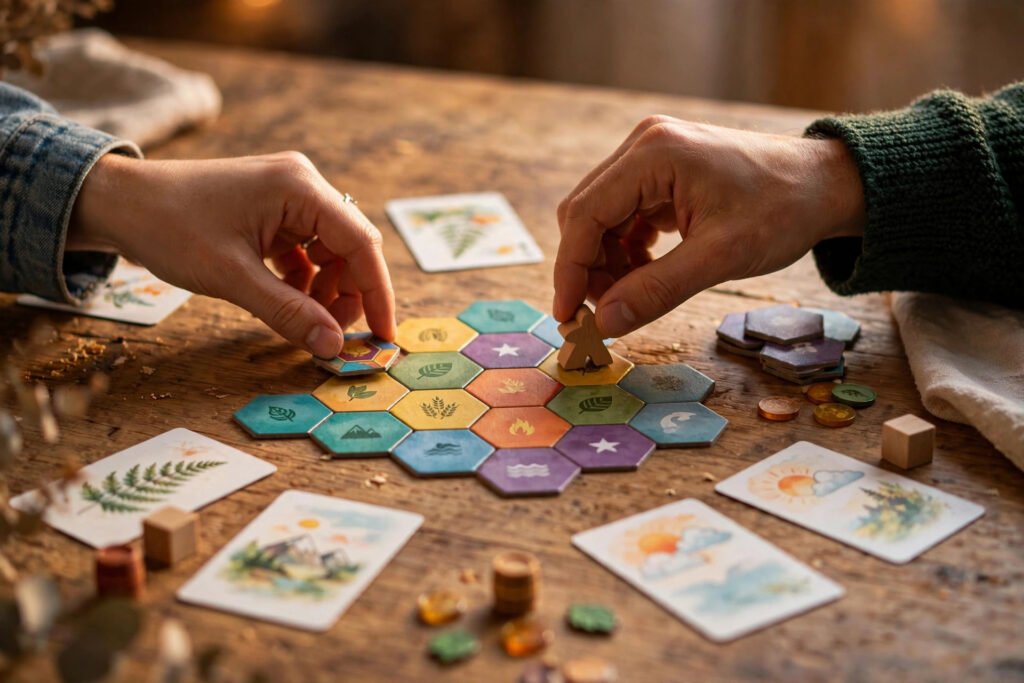
The best board games for two players are a different beast from party games — they need tension, meaningful decisions, and ideally no awkward “third player” mechanics bolted on. My partner and I have a standing Sunday game night, just the two of us, and we’ve played our way through dozens of contenders. Some were brilliant; some are now charity-shop donations. These are the keepers — the games designed (or perfectly adapted) for two that we return to again and again.
The Strategy Classics
- 7 Wonders Duel: the two-player version of the beloved civilization-builder, and arguably better than the original. Draft cards, build wonders, win by science, military or points. Tense, clever, 30 minutes. Our most-played game, by a mile.
- Patchwork: two players quilt Tetris-like pieces onto a board. Sounds dull; is utterly absorbing. 20 minutes, beautiful, and the perfect “one more game” length.
- Jaipur: trading and camels in an Indian market. Simple rules, surprising depth, 30 minutes. The ideal gateway game for non-gamers.
- Azul: gorgeous Portuguese tiles, deceptively simple placement rules, and the delicious agony of watching your opponent take the tiles you wanted. Plays brilliantly at two.
- Chess (but make it fun): if you want the deep end, chess remains the ultimate two-player game — and learning together from scratch is a genuine joy. The free apps make practice painless.
Co-operative Games: Win or Lose Together
Co-ops are perfect for couples because there’s no loser — you beat the game together or it beats you. Pandemic (save the world from diseases; tense, thematic, superb at two) is the classic. The Crew (a trick-taking card game with mission structure; tiny box, huge game) is my top recommendation for the price — under £15 and endlessly replayable. Spirit Island is the heavyweight: complex, rewarding, and the rare co-op where one player can’t quarterback the other. For lighter fare, Forbidden Island/Desert are 30-minute co-operative adventures that work beautifully as introductions.
Quick Card and Dice Games
For weeknights when 30 minutes is all you have: Love Letter (16 cards, 20 minutes, delicious deduction), Schotten Totten (poker-like clan battles; Reiner Knizia’s two-player masterpiece), Air, Land & Sea (18 cards, 20 minutes of tactical warfare), and Qwixx (a dice game that’s dangerously moreish). These live in a drawer by the sofa in our house — the barrier to playing is essentially zero, which means they get played.
Best Board Games for Two Players: What to Avoid
Be wary of games labelled “2–6 players” where two is an afterthought — many area-control and negotiation games fall flat without the table politics of 3+. Check reviews specifically for two-player impressions before buying. Also: avoid the temptation to buy the massive epic first. Start with a £15–£25 small-box game (Jaipur, Patchwork, The Crew), play it twenty times, and then decide if you want the £60 big box. The best game is the one that hits the table, not the one that looks impressive on the shelf.
For bigger groups, our guides to planning a games night and the best family board games for Christmas cover the multiplayer end. And if your duo wants something active, adult party games has options that scale down.
Where to Buy (Without Overpaying)
Board games have a real price spread, and the savvy buyer saves significantly. Online specialists (as opposed to the big general retailers) typically discount 15–25% off RRP as standard — never pay full price without checking. Charity shops are the board gamer’s secret: games donated complete and barely played for £2–£4. Check the pieces before buying (a quick count against the manual), but the hit rate is excellent. eBay and Facebook Marketplace for the out-of-print gems. Board game cafés let you try before you buy — play it three times over coffee before committing £40, which is the single best purchasing discipline in the hobby. And ask for games as gifts — board gamers’ birthdays and Christmases are largely self-funding if the family knows your wishlist. Which? reviews popular board games periodically, which helps when you’re choosing between the big names.
Learning New Games Without the Pain
The barrier to new games is learning the rules, and there’s a right way to do it. Watch a “how to play” video (10–15 minutes) rather than reading the manual cold — seeing the game played teaches faster than any rulebook. One person learns, then teaches: don’t make both players read the rules; one learns properly and teaches the other in five minutes, as our games night guide recommends. Play the first game open-handed: both players show their cards and talk through decisions — it’s a tutorial, not a competition. Accept the first game is a learning game: you’ll get rules wrong; that’s fine. Look them up, laugh, play again. By the third play you’ll be fluent, and that’s when the real game begins — the strategy, the mind games, the rivalry. Every favourite game was once a confusing box of bits. Push through the first hour and the next fifty are pure pleasure.
The Classics Never Die (and Shouldn’t)
Before the modern board game renaissance, there were the ancient two-player games — and they’re still superb. Chess: the ultimate — infinite depth, free to learn, played everywhere. The learning curve is real, but the free apps (with lessons and puzzles) make starting easier than ever. Go: the 4,000-year-old Chinese game — simpler rules than chess, deeper strategy; the handicap system lets mismatched players compete fairly. Backgammon: the perfect pub game — luck and skill in ideal balance, 20 minutes a game, and the doubling cube adds delicious tension. Scrabble (two-player): slower, more tactical than the multiplayer game — the board becomes a chess match of word placement. Cards: gin rummy, cribbage — the traditional two-player card games that have survived centuries because they’re perfectly designed. These games are free or nearly free, need no batteries, and have outlasted every trend. Learn one properly and you own it for life.
When to Play What: Matching Game to Mood
The collection is only useful if you reach for the right box. Tired weeknight, 20 minutes: Patchwork, Love Letter, Qwixx — low rules overhead, quick payoff. Sunday afternoon, proper session: 7 Wonders Duel, Azul — the strategic main events. One of you is new to gaming: Jaipur — teaches in five minutes, delights for fifty plays. Feeling cooperative: The Crew — win together or not at all. Feeling competitive: Schotten Totten — direct, tactical, no luck to blame. Rainy holiday with time to kill: the big box you’ve been saving — this is what it was bought for. Keep the quick games by the sofa (zero friction) and the big games on the shelf (occasion games). The right game at the right moment is the difference between a collection that’s played and a collection that’s displayed. For bigger groups, our games night guide scales the principles up.
The takeaway: 7 Wonders Duel for strategy, The Crew for co-operation, Jaipur for beginners, Patchwork for a quick fix. Start small, play often, and may the best quilter win.