Best Ways to Learn Maths as an Adult in Britain
The best ways to learn maths as an adult in Britain: free resources, Functional Skills and GCSE routes, beating maths anxiety and study methods that work.
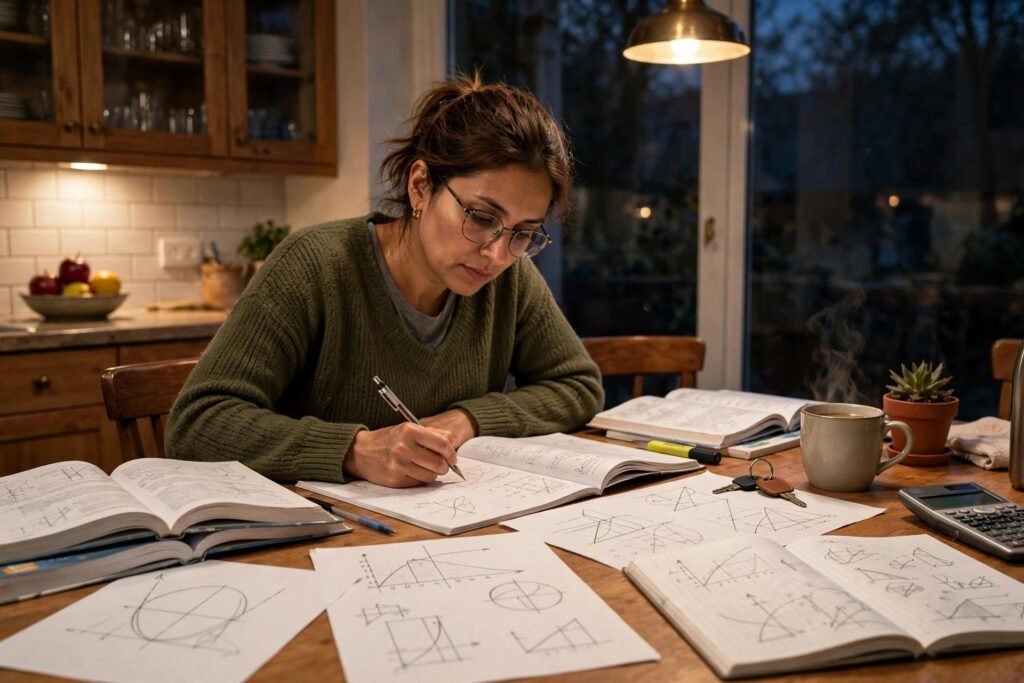
“I’m just not a maths person.” It’s the most common sentence in British adult education — and it’s almost always wrong. Decades of research show that mathematical ability isn’t a fixed trait but a trainable skill, and that the “maths person” identity is usually just the scar tissue of bad teaching received at age fourteen. Whether you need maths for a career change, to help your children, or to finally kill the anxiety, learning as an adult works differently — and often better — than learning as a teenager.
Why Adult Learners Have Hidden Advantages
Adults learning maths bring assets teenagers lack: motivation (you’re here by choice), life context (percentages mean something when they’re your mortgage), and metacognition (you know how you learn). Studies of adult numeracy consistently find that motivated adults progress faster than school-age learners covering the same material — partly because they connect abstract concepts to real experience immediately.
The main obstacle isn’t ability but maths anxiety — the genuine physiological stress response many adults feel facing numbers. Brain imaging shows it activates pain centres. The good news: anxiety drops rapidly with successful practice. The strategy is to start embarrassingly easy, accumulate wins, and let confidence compound. Beginning with material that feels “too easy” isn’t wasting time; it’s rebuilding the neural association between maths and success.
Step One: Find Your True Level (It’s Lower Than You Think)
Most adults overestimate what they’ve retained and underestimate what they need. The honest diagnostic: try the BBC Bitesize maths sections or the free assessments from the National Numeracy charity. National Numeracy’s free challenge checks your everyday maths and builds a personal learning plan — it’s designed for exactly this purpose and carries no stigma.
Common gaps in adult learners: fractions and decimals (the foundation everything else needs), percentages (especially reverse percentages — “£60 after 20% off, what was the original?”), ratio and proportion, and basic algebra (which is just arithmetic with letters, despite its fearsome reputation). Identifying your specific gaps beats re-doing entire curricula.
The Free Resources That Actually Work
National Numeracy (free). The UK charity dedicated to adult numeracy. Free assessments, learning resources and the National Numeracy Challenge. Start here — it’s British, structured and shame-free.
Khan Academy (free). The world’s best free maths teaching, from counting to calculus. The mastery system won’t let you advance until you’ve genuinely learned each topic, which prevents the “I sort of get it” illusion. Use the UK maths courses aligned to GCSE content.
BBC Bitesize (free). Designed for GCSE students but perfect for adults — clear, concise, British curriculum, with videos and quizzes. Nobody will know you’re using the “school” resource; plenty of adults do.
Functional Skills courses (often free). Further education colleges across Britain offer Functional Skills Maths (Entry Level to Level 2, roughly GCSE-equivalent) — frequently free for adults without existing qualifications. These are practical, respected by employers, and structured with proper teaching. Check your local college; this is the highest-value option for qualification-seekers.
GCSE Maths as an Adult: Should You?
A GCSE in maths (grade 4/C or above) unlocks teaching, nursing, policing, the civil service and countless other careers — it’s the single most career-limiting qualification to lack in Britain. As an adult you can take it through: local FE colleges (often free if you don’t already have grade 4), evening classes, or online providers. One year of evening study is typical.
The adult GCSE experience differs from school: smaller classes of motivated peers, teachers who chose adult education, and no behaviour-management chaos. Pass rates for committed adult learners are strong. If your career needs it, this is one of the highest-return educational investments available — far more valuable than another degree for many career changers.
How to Study: The Adult Method
Little and often beats weekend marathons. Thirty minutes daily builds stronger retention than four hours on Sunday — spaced practice is the most robust finding in learning science. Attach it to an existing habit: maths with morning coffee.
Write everything down. Adults try to do steps mentally to “prove” competence; this causes errors and hides misunderstandings. Show every step on paper. Mathematicians do.
Embrace wrong answers. Each mistake reveals a specific misconception — that’s diagnostic gold. Keep an error log: the problem, your wrong approach, the correction. Reviewing it weekly prevents repeat errors.
Teach it to someone. Explaining fractions to your child or a study partner exposes gaps in your own understanding instantly. The protégé effect is real — teaching is the fastest way to learn.
Use AI tutors wisely. Modern AI tools can explain concepts step-by-step at 11pm when no human is available. But verify their maths independently (they make arithmetic errors) and use them for explanations, not answers — AI study tools are powerful when used as tutors rather than answer machines.
Maths for Specific Goals
Career change: identify the actual maths your target field needs (data analysis? finance? engineering?) and learn that specifically rather than “maths” generally. Targeted learning is faster and more motivating.
Helping children: learn one step ahead of them. Understanding this week’s homework deeply beats vague general knowledge — and your visible effort models the growth mindset schools preach.
Everyday confidence: focus on percentages, probability intuition, and statistics literacy — the maths of news headlines, medical risks and financial products. Understanding “30% increased risk” versus “30 percentage points” transforms how you read the world.
Dealing With Setbacks (They’re Normal)
You will hit topics that don’t click — algebra, fractions, trigonometry, whichever demon haunted your schooldays. This is normal, not evidence of inability. The adult strategy for stuck points: go back one level (struggling with algebraic fractions? Your numerical fractions need reinforcement first — the difficulty is almost always a gap underneath, not the topic itself), try a different teacher (Khan Academy’s explanation not landing? Try Bitesize, a YouTube tutor, or an AI explanation — the same concept taught five ways eventually finds the way your brain works), and sleep on it (genuinely — the brain consolidates learning overnight, and problems that baffle at 10pm often clarify by morning). The learners who succeed aren’t those who never get stuck; they’re those who treat stuck as information about what to review, not as a verdict on their intelligence. Every mathematician in history has been stuck. It’s the job.
The Bottom Line
You’re not “not a maths person” — you’re a person whose maths education failed them, which describes millions of capable adults. The path back is straightforward: diagnose your level honestly with free tools, start easier than your pride suggests, study thirty minutes daily, and consider a Functional Skills or GCSE course if qualifications matter for your goals. Within six months of consistent effort, most adults reach a level that would have seemed impossible — not because they became geniuses, but because they finally learned maths as adults: motivated, contextualised, and at their own pace.
Frequently Asked Questions
Am I too old to learn maths?
No. Adult brains retain full capacity for mathematical learning; what declines slightly with age is processing speed, not comprehension. Adults routinely pass GCSE maths in their 40s, 50s, 60s and beyond. Motivation predicts success far better than age.
How long does it take to get GCSE-level maths as an adult?
Typically one academic year of part-time study (evening classes or equivalent self-study) for someone starting from rusty school-level knowledge. Complete beginners may need longer; those refreshing old knowledge may need less. Functional Skills Level 2 can be faster.
Is Functional Skills as good as GCSE?
For most employment purposes, yes — Level 2 Functional Skills is officially equivalent to GCSE grade 4. Some specific professions (teaching, for instance) require actual GCSEs, so check your target career’s requirements before choosing.
Can I really do this without a teacher?
Many do, using Khan Academy, Bitesize and AI tutors. But a taught course (FE college, evening class) provides structure, accountability and someone to unstick you — the main reasons self-study fails are isolation and getting stuck. If self-study stalls twice, enrol somewhere.