How to Learn Piano Without a Teacher
How to learn piano without a teacher: a realistic self-taught plan with practice routines, free resources, technique basics and honest timelines. Begin today.
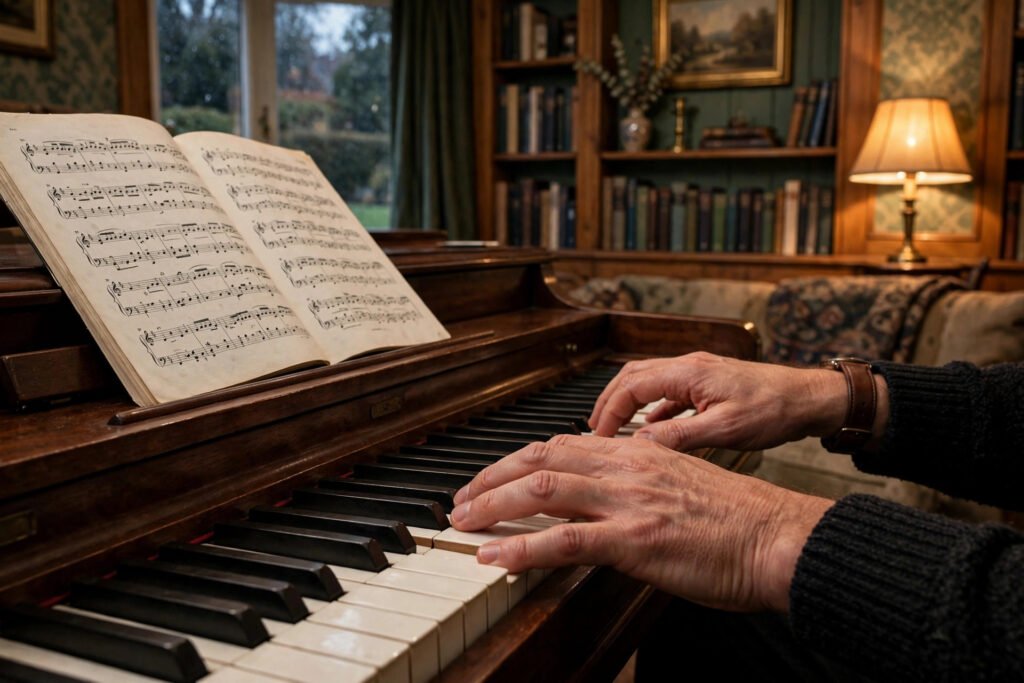
You have always wanted to play, but lessons feel expensive, scheduling feels impossible, and the idea of sitting through grades as an adult feels faintly absurd. Here is the liberating truth: some of the most joyful pianists alive taught themselves. Without a teacher, you trade structured accountability for freedom — which means your success depends on having a smart plan instead of a timetable. This guide gives you that plan: the instrument, the method, the practice routine, and the honest timeline for learning piano without a teacher.
We will cover choosing between a keyboard and a piano, the self-study method that actually works, reading music from scratch, technique that prevents injury, free and paid resources worth your time, and how to stay motivated when nobody is checking your homework.
First decision: what to play on
You do not need an acoustic piano. A digital piano with 88 weighted keys is the ideal self-taught instrument: it feels like the real thing, never needs tuning, and lets you practise with headphones at midnight. The Yamaha P-45 and P-125 and the Roland FP-30X are the perennial recommendations for beginners — all available second-hand on Gumtree or Facebook Marketplace for a fraction of retail, often from families whose children lost interest. Whatever you buy, insist on 88 fully weighted keys; unweighted keyboards teach finger habits you will later have to unlearn.
If budget is truly tight, a 61-key unweighted keyboard works for the first few months of learning notes and simple pieces, but plan to upgrade. Place the instrument so your elbows sit at roughly key height when seated — a dining chair and a stack of books works temporarily, but an adjustable piano stool or bench pays for itself in comfort. Good posture from day one prevents the wrist and back aches that derail many self-taught players.
The self-study method: how to structure learning alone
The biggest risk of teaching yourself is not lack of talent — it is lack of sequence. Random YouTube tutorials create gaps. Instead, follow a method book designed for adults. Alfred’s Basic Adult Piano Course is the classic: it teaches reading, rhythm and technique in small, logical steps with pieces that sound like real music quickly. Work through it page by page, and do not skip the “boring” theory boxes — they are the grammar of the language you are learning.
Structure each practice session in three blocks: ten minutes of technique (scales, five-finger patterns), fifteen minutes on your method book, and ten minutes of something you love — a favourite song, improvisation, or a piece above your level that inspires you. This 35-minute shape keeps practice balanced between discipline and joy. Practise daily if possible; twenty focused minutes beats two distracted hours. And record yourself weekly on your phone — progress is invisible day to day but obvious month to month, and those recordings become powerful motivation.
Reading music from scratch
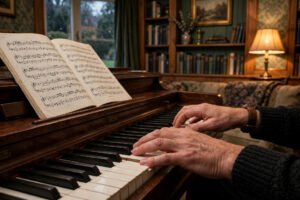
Sheet music looks like code until someone explains the cipher, and then it clicks fast. Start with the grand staff: the treble clef (right hand, roughly) and bass clef (left hand, roughly), with middle C sitting on a ledger line between them. Learn landmark notes — treble G (second line), bass F (fourth line from bottom) — and read other notes by counting steps from those anchors rather than memorising every line and space.
Rhythm is the part beginners underestimate. Clap rhythms before playing them, count out loud (“1-and-2-and”), and use a metronome app from the very first week — playing in time matters more than playing fast. Note values (semibreves, minims, crotchets, quavers) are just fractions of a bar; learn them as maths and they stop being mysterious. Within a month of daily reading, simple pieces will feel legible. For graded milestones to aim at, ABRSM’s official guidance describes what each grade expects — many self-taught adults sit Grade 1 within a year as a satisfying checkpoint, and Making Music, the UK community music network, can point you toward local groups when you are ready to play with others.
Technique that keeps you injury-free
Without a teacher watching your hands, you must become your own technique coach. The fundamentals: curved fingers (imagine holding a small ball), relaxed wrists that float level with the keys, thumbs that pass under smoothly in scales, and arms that carry the weight rather than fingers that press. Tension is the enemy — if your forearms ache, you are working too hard. Shake your hands out, drop your shoulders, and replay the passage slower.
Scales are the vegetables of piano: unglamorous, essential. Learn C major, G major and F major hands separately, then together, slowly, with a metronome. They train evenness, fingering logic and key geography simultaneously. Hanon exercises have devotees and detractors; a few minutes of five-finger patterns deliver most of the benefit without the tedium. And film your hands from above occasionally — you will spot collapsed finger joints or flying pinkies that you cannot feel in the moment.
Resources worth your time (and which to skip)
The internet is drowning in piano content, so curate ruthlessly. For structured video learning, Pianote’s YouTube channel and website offer genuinely pedagogical lessons rather than clickbait. Josh Wright’s channel is superb for technique deep-dives once you are past the basics. Apps like Flowkey and Simply Piano work well as supplements — their note-recognition feedback is motivating — but treat them as practice aids, not curricula; they tend to rush you past reading skills. Starting a vinyl record collection on a budget is a fine parallel hobby for training your ear, by the way — listening deeply to great recordings teaches musicality no app can.
Skip anything promising “play piano in 7 days” or teaching only via falling-note videos with no notation. Synthesia-style visuals can help you learn a specific song fast, but they bypass reading entirely, leaving you dependent on the crutch. The debate about whether AI-generated music matches human-made music is interesting, but no AI shortcut replaces the slow, satisfying work of training your own hands.
Staying motivated with no teacher watching
Motivation is the true curriculum of self-teaching. Set process goals (“practise 20 minutes daily”) rather than outcome goals (“master this piece”), because you control the former. Keep a practice log — a simple notebook where you note what you worked on — and you will be amazed how it sustains momentum. Learn pieces you genuinely love, not just method-book exercises; the song that made you want to play is the fuel that gets you through plateaus.
Find community. Adult learner groups, both online and local, normalise the struggle — everyone battles the same tricky bar. Perform for someone, even informally, every couple of months; nothing focuses practice like a deadline. And reframe plateaus: weeks where nothing seems to improve are usually when your brain is consolidating. The players who quit are not the untalented ones — they are the ones who mistook a plateau for a ceiling.
An honest timeline
With 20–30 minutes of daily practice: within a month, you will read simple music and play easy pieces hands together. Within six months, expect confident basic pieces, major scales, and simple chord accompaniments. Within a year, early-intermediate repertoire and genuine musical expression. Within two years, you will be the person friends ask to play at gatherings. It is slower than lessons with a great teacher — but it is real, it is yours, and it starts the day you sit down.
Conclusion
Learning piano without a teacher demands a method book for sequence, a weighted keyboard for honest feedback, daily short practice, and the humility to film your own hands. Follow this plan and you will join the long tradition of self-taught musicians who prove that guidance helps, but curiosity and consistency are the real teachers.
Frequently Asked Questions
Can I really learn piano as an adult beginner?
Yes. Adults learn differently from children — slower at first, but with better understanding and discipline. Countless adults reach intermediate level and beyond through self-study, especially with consistent daily practice.
Is a keyboard enough, or do I need a real piano?
An 88-key weighted digital piano is ideal and far more practical than an acoustic for most homes. Avoid unweighted keyboards long-term, as they teach finger technique that does not transfer to real pianos.
How long before I can play a proper song?
Simple recognisable pieces typically come within 4–8 weeks of daily practice using a method book. More impressive pieces — the ones that make people stop and listen — usually take 6–12 months.
Should I still consider occasional lessons?
Even mostly self-taught players benefit enormously from an occasional check-up lesson — say, once every couple of months — to catch technique issues before they become habits. Many teachers offer single sessions for exactly this.