How to Take Better Notes During Lectures
How to take better notes during lectures: Cornell, outline and mind-map methods, plus digital tools that keep notes useful come revision time. See how it works.
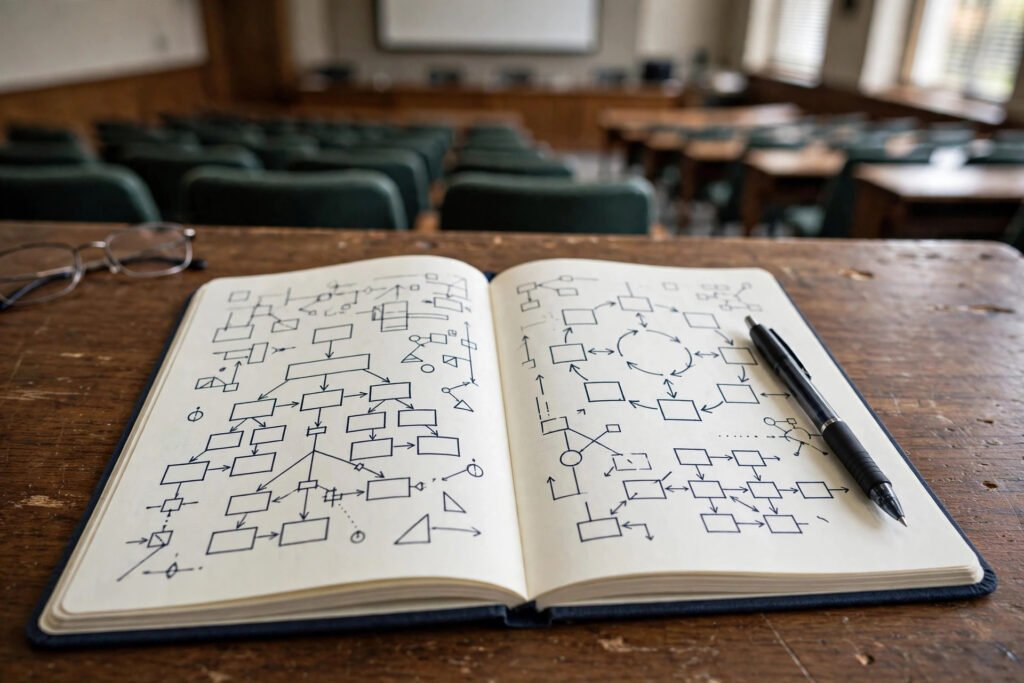
You sit through a fifty-minute lecture, pen moving the whole time, and leave with four pages of… what, exactly? A transcript of the slides, half-understood, never to be read again. Most students take notes the way they were never taught not to: transcribing instead of thinking. But note-taking is a learnable skill, and the research is clear about what works. This guide shows you how to take better notes during lectures — methods that turn passive scribbling into active learning.
We will cover why most notes fail, the Cornell method, outline and mind-mapping, digital versus handwritten, and turning notes into revision gold.
Why most lecture notes fail
The default student strategy — copying everything verbatim, often from slides — feels thorough and achieves little. Transcription bypasses thinking: your hand moves while your brain idles, and the result is a document you have processed so shallowly it might as well belong to someone else. Studies comparing note-taking strategies find that students who take fewer, more processed notes consistently outperform verbatim transcribers on conceptual tests.
The goal of notes is not a record; it is a thinking tool. Good notes capture the lecture’s structure, the key ideas in your own words, your questions and confusions, and the connections to other material. They should be useful three months later without the lecture’s context — which means they need your thinking embedded in them, not just the lecturer’s words. Everything below serves that goal.
The Cornell method: the classic that works
Divide each page into three zones: a wide right column for notes, a narrow left column for cues, and a summary strip at the bottom. During the lecture, take notes in the right column — concise, in your own words, structured. After the lecture (within 24 hours, while memory is fresh), fill the left column with cue words and questions (“What are the three causes of…?”), and write a 2–3 sentence summary at the bottom.
The magic is in the review: cover the right column, use the cues to quiz yourself, then check. This builds retrieval practice directly into your notes — the most evidence-backed study technique there is. The summary forces synthesis: if you cannot summarise the lecture in three sentences, you did not understand it, and now you know what to revisit. Cornell notes take slightly longer than scribbling, and they pay back triple at revision time.
Outline and mind-mapping: structure your thinking
The outline method suits structured, hierarchical lectures: main topics as headings, sub-points indented beneath, details further indented. Use abbreviations, symbols and your own shorthand liberally — notes are for you, not publication. The discipline of indenting forces you to identify relationships (is this an example? a counterargument? a definition?), which is active processing disguised as formatting.
Mind-mapping suits discursive or creative lectures: central topic in the middle, branches for themes, sub-branches for details, with colours and doodles welcomed. It mirrors how the brain associates and is superb for essay planning later. Many students hybridise: outline during the lecture for speed, then convert to a mind map afterwards as a synthesis exercise — which doubles as revision. For digital tools supporting these methods, the best AI tools for students on a budget covers apps worth trying.
Handwritten vs digital: the honest verdict
The famous “pen is mightier than keyboard” study found handwriters outperformed typists on conceptual questions — because handwriting’s slowness forces selection and paraphrasing, while typing enables mindless transcription. But the effect depends on how you use the tool: typists who deliberately summarise rather than transcribe do just as well. The medium matters less than the method.
Practical guidance: handwrite if your lectures are conceptual and your handwriting is legible; type if lectures are fact-dense, fast, or involve materials you will search later (typed notes are searchable, shareable and backup-able). Tablets with styluses offer a genuine best-of-both: handwriting’s processing with digital’s organisation. Whatever you choose, the non-negotiable is reviewing within 24 hours — unreviewed notes, however taken, decay into uselessness. And the device question extends beyond lectures: whether a Chromebook or laptop is better for students affects your whole study setup.
Before, during and after: the full routine
Great notes start before the lecture: skim the slides or reading for ten minutes, noting the topic structure and writing down two questions you want answered. This primes your brain to recognise key points — you will hear the lecture differently. During: sit where you can see and hear, date every page, mark confusion clearly (a big “?” in the margin) rather than faking understanding, and note the lecturer’s emphasis cues (“the key point here is…”, repetitions, things written on the board).
After — the step almost everyone skips: spend ten minutes reviewing, filling gaps while memory is fresh, writing the Cornell summary, and converting confusion-marks into questions for tutorials or office hours. This ten minutes is worth more than an hour of later re-reading. UCAS and The Open University both publish excellent study-skills guides reinforcing these habits.
Turning notes into revision
Notes are raw material; revision is manufacturing. In the weeks before exams, transform notes actively: condense each lecture to one page, then to one side, then to cue cards — each condensation is retrieval practice. Create practice questions from your cue columns. Teach the material aloud from your summaries. The students with the best exam results are rarely those with the most beautiful notes — they are those who processed their notes most actively, most often.
Notes for different lecture types
Adapt your method to the material. Maths and science lectures: prioritise worked examples — copy each step with brief annotations of why, since the reasoning matters more than the result. Humanities lectures: track arguments — thesis, evidence, counterarguments, your own critical responses. Fast-talking lecturers: abandon completeness and capture headings plus key terms, filling gaps from slides afterwards. Guest lectures and one-offs: focus on quotable insights and references to follow up. The method serves the material, not vice versa.
Conclusion
Better lecture notes mean thinking, not transcribing: prepare briefly beforehand, use Cornell, outline or mind-map during, review within 24 hours, and convert notes into active revision. Master this and lectures stop being something that happens to you — they become raw material you actively refine into lasting understanding.
Frequently Asked Questions
What is the Cornell note-taking method?
Divide the page into notes (right), cues/questions (left) and summary (bottom). Take notes during the lecture, add cues and a summary within 24 hours, then self-quiz using the cues — building retrieval practice into your notes.
Is it better to handwrite or type lecture notes?
Handwriting forces selection and paraphrasing, aiding conceptual understanding; typing suits fast, fact-dense lectures and gives searchable notes. The method (active processing, 24-hour review) matters more than the medium.
How do I take notes in fast-paced lectures?
Prepare by skimming slides beforehand, use abbreviations and symbols, focus on structure and key ideas rather than transcription, mark confusion with “?” to revisit, and fill gaps within 24 hours while memory is fresh.
How should I use lecture notes for revision?
Condense progressively (lecture → one page → cue cards), create practice questions from cue columns, and teach material aloud from summaries. Active transformation beats passive re-reading every time.