How to Read Sheet Music: A Beginner’s Guide That Clicks
How to read sheet music: beginner’s guide to the staff, clefs, key signatures, notes and rhythms, with simple exercises that build genuine reading skill quickly.
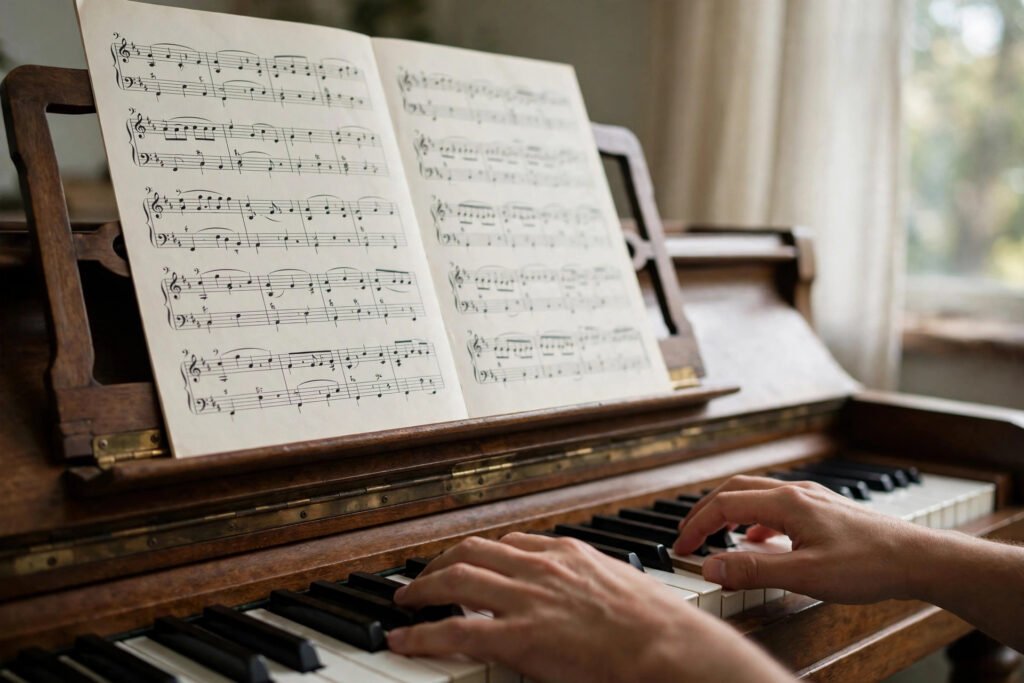
Sheet music looks like an encrypted secret: five lines, scattered dots, cryptic symbols, Italian words. Yet it is one of humanity’s most successful technologies, a 1,000-year-old system for freezing sound in time so precisely that a musician in Tokyo can reproduce exactly what a composer in Vienna imagined centuries ago. And it is far more learnable than it looks.
This beginner’s guide demystifies the whole system step by step: the staff, the clefs, rhythm, and the practice methods that turn symbols into music. No prior knowledge assumed.
The Staff: Five Lines That Hold Everything
Everything in Western notation hangs on the staff: five horizontal lines with four spaces between them. Each line and space represents a pitch, ascending from bottom to top. Notes are placed on lines or in spaces; when the music goes higher or lower than the staff allows, short extra lines called ledger lines extend it.
Think of the staff as a ladder: each rung is the next note of the scale. Once you internalise that pitches rise as notes climb the page, the system’s logic clicks. The staff is not arbitrary decoration; it is a graph with pitch on the vertical axis.
Clefs: The Key to the Map
A clef tells you which pitches the lines represent, like the legend on a map. The treble clef (the fancy G symbol) wraps around the second line, declaring it G, and is used for higher instruments and voices: violin, flute, trumpet, and the right hand of the piano. The bass clef (the backward C with two dots) marks the fourth line as F, serving lower instruments and the piano’s left hand.
Learn one clef thoroughly before adding the second. Pianists need both eventually, but starting with treble alone removes half the confusion. Mnemonics help: treble lines are E-G-B-D-F (“Every Good Boy Deserves Fudge”), spaces spell F-A-C-E.
Notes and Their Lengths
Note shapes encode duration. A semibreve (whole note) is an open oval: four beats. A minim (half note) adds a stem: two beats. A crotchet (quarter note) fills the oval in: one beat. Quavers (eighth notes) add a flag or beam: half a beat each. Rests, the symbols for silence, follow the same hierarchy and matter just as much: music is sound shaped by silence.
British and American names differ (crotchet versus quarter note), which confuses beginners using mixed resources. Pick one system and stick with it; the concepts are identical.
Rhythm: Making It Groove
Rhythm is where notation comes alive. The time signature, two numbers at the start, tells you the beat structure: 4/4 means four crotchet beats per bar, the heartbeat of most popular music. Count aloud while clapping: “1-2-3-4”, emphasising beat one. Then subdivide: quavers get “1-and-2-and”, building the internal clock every musician needs.
Start rhythmically simple. March-like 4/4 pieces with crotchets and minims build confidence; dotted rhythms and syncopation come later. A metronome, or a free metronome app, is the most honest practice partner you will ever have.
Sharps, Flats, and Key Signatures
Sharps raise a note by a semitone, flats lower it, and naturals cancel them. A key signature, the cluster of sharps or flats after the clef, tells you which notes are altered throughout the piece, defining its key. Rather than memorising all of them at once, learn the keys of the pieces you actually play; theory serves practice, not the reverse.
Dynamics (loud and soft markings), tempo words (allegro, adagio), and articulation symbols (staccato dots, legato slurs) are the expressive layer: they turn correct notes into music. Learn these in context as they appear in your pieces.
How to Practise Effectively
Effective practice is deliberate, not long. Work in focused 20-minute sessions: identify the two hardest bars, play them slowly enough to get them right, then gradually increase tempo. Hands separately before hands together for pianists. Say note names aloud while playing to fuse reading with doing.
Sight-reading, playing unfamiliar music at first glance, is a separate skill worth training daily: pick something easy, keep going without stopping for mistakes, and resist the urge to perfect it. Fluency comes from volume of reading, not perfection of any single piece. The BBC’s music education resources offer structured exercises for beginners.
Putting It Together: Your First Month
Week one: learn the treble clef lines and spaces, and clap rhythms in 4/4. Week two: play simple five-finger melodies while naming notes aloud. Week three: add the bass clef basics and simple hands-together patterns. Week four: sight-read one easy piece daily and learn your first complete tune. By month two, you will read simple music with growing confidence; by month six, intermediate pieces feel achievable.
Connect reading to listening: follow along with scores while hearing the music, whether in the best musicals for first-timers or your own practice pieces. Seeing notation map to sound you love accelerates everything. And feed your broader musical curiosity: starting a vinyl collection on a budget deepens the listening habit that motivates the reading. The Musicians’ Union learning resources can point you toward teachers when you are ready.
Reading Music in the Digital Age
Technology has transformed how beginners learn notation. Apps offer interactive sight-reading exercises with instant feedback, gamifying the repetition that builds fluency. Digital sheet music libraries put millions of scores at your fingertips, transposable to any key instantly. Slow-downer software lets you hear complex passages at half speed while following the notation, bridging ear and eye. None of this replaces a good teacher for correcting bad habits early, but the self-directed learner of 2026 has resources previous generations could not imagine. One caution: screen-reading encourages skimming, so still practise with printed music regularly; the physical page trains the eye differently. The tools are means, not ends: the goal remains the same as it was in 1026, to turn symbols into sound.
Conclusion
Reading sheet music is a learnable skill, not a talent: staff as pitch-ladder, clefs as legends, note shapes as durations, and rhythm as counting. Practice deliberately, sight-read daily, and connect the symbols to music you love. In a few months, those mysterious dots become what they truly are: instructions for joy.
Frequently Asked Questions
How long does it take to learn to read sheet music?
Basic reading takes one to three months of regular practice; comfortable sight-reading of intermediate pieces typically takes six to twelve months. Daily short sessions beat occasional long ones.
Is it harder to learn as an adult?
Adults often learn faster initially thanks to better discipline and pattern recognition, though children develop fluency more naturally over years. There is no age at which it becomes impossible.
Do I need to learn both treble and bass clef?
Pianists need both; most other instrumentalists and singers need only their own. Start with one clef and add the second when the first feels comfortable.
What is the best instrument for learning to read music?
Piano is ideal: the keyboard maps visually to the staff, and you learn both clefs together. But the best instrument is the one you actually want to play.
Can I learn to play without reading music?
Yes, many excellent musicians play by ear. But reading opens up centuries of repertoire, accelerates learning, and lets you communicate precisely with other musicians. It is worth the effort.