Best Study Techniques Backed by Science (2026)
Best study techniques backed by science in 2026: spaced repetition, retrieval practice and interleaving explained for real exam results. Start with this guide.
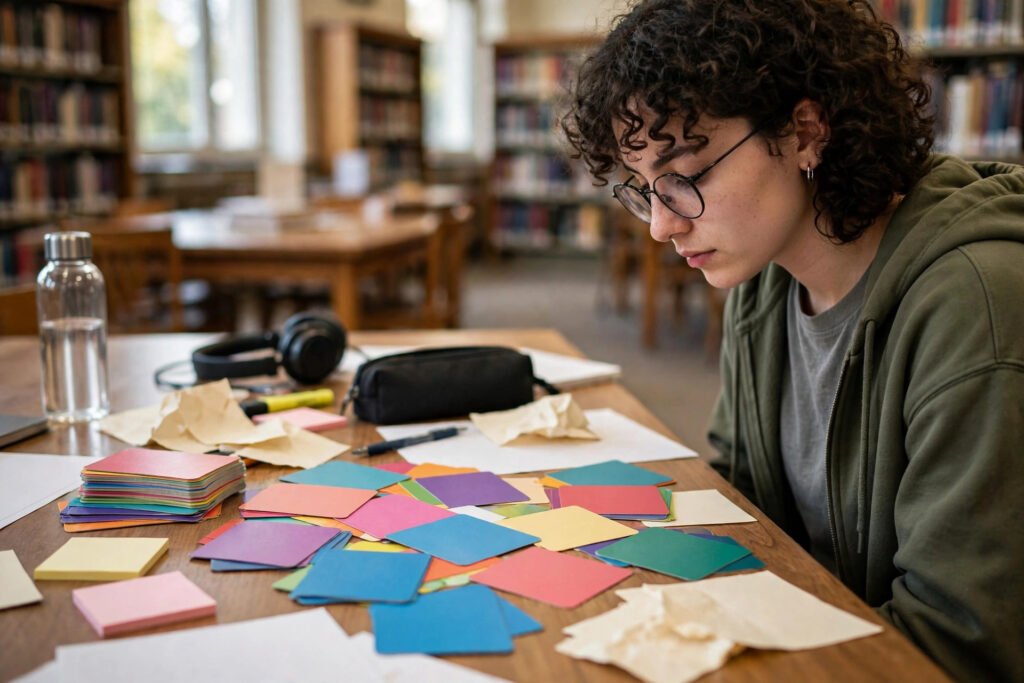
Most students study hard but study wrong: re-reading notes, highlighting textbooks, copying out slides — techniques that feel productive while barely denting memory. Cognitive science has spent decades identifying what actually works, and the findings are gloriously counterintuitive: the harder your brain works to retrieve information, the better it remembers it. This guide covers the best study techniques backed by science in 2026 — the methods with real evidence behind them, and how to use them.
We will cover retrieval practice, spaced repetition, interleaving, elaboration, the truth about learning styles, and building a science-based study system.
Retrieval practice: test yourself, constantly
The single most powerful study technique known to science is also the simplest: practise recalling information from memory. Testing yourself — with flashcards, past papers, or simply closing the book and writing down everything you remember — strengthens memory far more than re-reading the same material. This “testing effect” is one of the most replicated findings in psychology, holding across subjects, ages and ability levels.
The mechanism: retrieval is effortful, and effortful processing builds stronger memory traces — “desirable difficulty,” as researchers call it. Practical application: after reading a chapter, close it and summarise from memory; use blank-page recall before revising a topic; do past paper questions under timed conditions early and often, not just at the end. Embrace getting things wrong — failed retrieval followed by checking the answer still beats re-reading, because the struggle itself encodes the memory. Low-stakes quizzing should be the backbone of every study session.
Spaced repetition: timing is everything
Cramming works for tomorrow’s test and fails for next month’s exam — the forgetting curve guarantees it. Spaced repetition distributes review across expanding intervals (one day, three days, a week, a month), and the evidence for its superiority over massed practice is overwhelming. Each well-timed review interrupts forgetting just as the memory fades, strengthening it further.
Flashcard apps like Anki automate the scheduling: cards you find hard appear sooner, easy ones later, optimising every minute. The technique suits facts, vocabulary, formulae and definitions — anything with clear right answers. For essays and concepts, spaced retrieval means revisiting topics on a schedule: learn it, test yourself after a day, again after three days, again before the exam. The upfront effort of building the system pays off exponentially — students using spaced repetition routinely outperform crammers while studying fewer total hours. AI tools can help generate practice questions, but use them critically — whether schools should ban students from using AI for homework is a live debate precisely because outsourcing thinking undermines learning.
Interleaving: mix it up
Blocked practice — mastering topic A, then topic B, then topic C — feels logical but produces fragile learning. Interleaving mixes topics within a session: a bit of A, a bit of C, back to B. It feels harder and less productive, which is exactly why students resist it — but test performance consistently favours interleavers, because exams themselves interleave, and because mixing forces your brain to discriminate between problem types.
In practice: when revising maths, do mixed problem sets rather than twenty identical questions; when studying history, alternate periods or themes; when learning languages, mix vocabulary topics. The discrimination practice — “which method does this problem need?” — is the skill exams actually test. Combine interleaving with retrieval: mixed, self-tested sessions are the gold standard. For study tech that supports these methods, the best AI tools for students on a budget covers quiz generators and flashcard apps worth trying.
Elaboration: connect it to stick it
Memory is associative: new information sticks when linked to what you already know. Elaborative interrogation — asking “why?” and “how?” about facts — transforms isolated data into connected understanding. Why does this historical event follow that one? How does this formula derive from that principle? Students who generate explanations outperform those who merely memorise, even on factual tests.
The Feynman Technique operationalises this: learn a concept, then teach it simply — aloud, on paper, to an imaginary twelve-year-old. Gaps in your explanation reveal gaps in understanding; fill them and repeat. Concrete examples beat abstract definitions: attach each concept to a vivid, specific case. And self-explanation during problem-solving (“I am doing this step because…”) measurably improves transfer to new problems. Understanding is not the enemy of memorisation — it is its most powerful ally.
The myths: learning styles and highlighting
Time to retire two zombies. “Learning styles” (visual/auditory/kinaesthetic) have no credible evidence: matching instruction to supposed style does not improve learning. What matters is matching the method to the material — diagrams for spatial relationships, practice for skills, retrieval for facts. Everyone benefits from multiple modalities.
Highlighting and re-reading — students’ favourite techniques — rank among the least effective in comprehensive reviews of study research. They create fluency illusions: the text feels familiar, so you mistake recognition for knowledge. If you highlight, do it only to mark material for later retrieval practice, never as the practice itself. Summarising helps modestly, but only when done from memory (making it retrieval) rather than while looking at the source. The uncomfortable truth: effective studying feels harder than ineffective studying. Trust the effort, not the comfort.
Building your system
Assemble the evidence into a weekly rhythm: learn new material with elaboration and concrete examples; convert it into retrieval practice (flashcards, questions, blank-page summaries); schedule spaced reviews via Anki or a simple calendar system; interleave topics within sessions; and do past papers under exam conditions regularly from early in the term. Protect sleep ruthlessly — memory consolidation happens during sleep, and all-nighters destroy the very encoding you need.
Study in focused blocks (50 minutes work, 10 rest) with phone elsewhere; exercise regularly (it measurably boosts cognition); and teach others whenever possible — study groups where members explain concepts to each other outperform solo re-reading dramatically. UCAS offers study skills resources for applicants, and GOV.UK publishes guidance on exam preparation and wellbeing. The science is clear; the system is simple; the only variable is whether you will trust the harder-feeling methods.
Conclusion
The best study techniques backed by science are retrieval practice, spaced repetition, interleaving and elaboration — all harder-feeling and all more effective than re-reading and highlighting. Build them into a system, protect your sleep, and let desirable difficulty do the heavy lifting. The students who thrive are not the ones who study longest — they are the ones who study smartest, using methods proven by decades of research. Study less, remember more — starting with your very next session.
Frequently Asked Questions
What is the most effective study technique?
Retrieval practice — actively recalling information through self-testing, flashcards or blank-page recall. It is the most replicated finding in study science, outperforming re-reading across subjects and ages.
Does cramming work for exams?
For next-day recall, marginally; for lasting learning, no. Spaced repetition across expanding intervals dramatically outperforms massed cramming, usually in fewer total study hours.
Are learning styles real?
No credible evidence supports matching teaching to visual/auditory/kinaesthetic “styles.” Match the method to the material instead — everyone benefits from varied, effortful techniques.
How does sleep affect studying?
Profoundly — memory consolidation occurs during sleep. All-nighters impair the encoding and recall you need; regular 7–9 hour sleep is among the highest-impact “study techniques” available.