How to Explain Evolution to a Curious Child
Wondering how to explain evolution to a curious child? Simple analogies, answers to tricky questions and fun activities that make natural selection click.
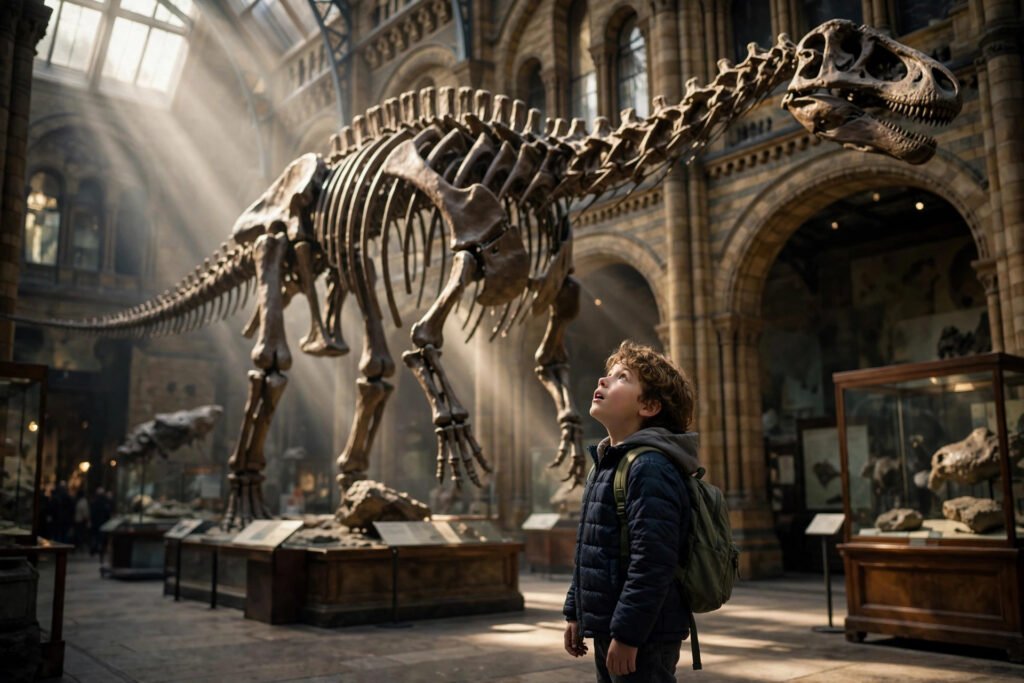
“But where did people come from?” Every parent eventually faces the evolution question, and the temptation is to either dodge it or drown the child in jargon about allele frequencies. Neither works. Children are natural scientists — they already understand that puppies look like their parents and that some animals are better at hiding than others. Explaining evolution to a curious child means building on those intuitions with stories, examples and honesty about what science does not yet know. Here is how to do it at every age.
Start with what they already know: variation and inheritance
Begin with the familiar. Ask why they look like their family but not identical to anyone — children grasp inheritance intuitively. Then point out variation: no two dogs, cats or people are exactly alike, even siblings. Farmers and breeders have exploited this for millennia, choosing the fastest horses or the woolliest sheep to breed from, gradually shaping domestic animals. This is artificial selection, and children can see it in every pug and dairy cow. Then comes the key leap: nature does the same choosing, without any breeder. That is the whole idea of evolution by natural selection, and once a child sees the breeder analogy, the rest follows naturally.
The story version (ages 4–7)
Young children think in stories, so tell one. “A long, long time ago, there were animals a bit like mice living alongside the dinosaurs…” Narrate a simple tale: in a forest, brown mice hide well but white mice get spotted by owls; the brown mice survive and have brown babies; slowly, over thousands of mouse generations, the forest is full of brown mice. Then change the setting — the mice move to a snowy field — and let the child predict what happens next. They will get it: now white hides better. You have just taught natural selection, and they taught themselves the second half. Picture books with timelines help enormously, and a trip to see the real fossils makes it tangible — a rainy-day trip to the Natural History Museum in London, with its dinosaurs and human ancestors, turns the story into something they can touch.
The evidence version (ages 8–12)
Older children want proof, and evolution has spectacular proof. Fossils: show the progression from early whales with legs to modern whales, or the feathered dinosaurs that blur the line into birds. DNA: explain that humans share about 98–99 per cent of DNA with chimpanzees and even 60 per cent with bananas — the genetic record confirms the family tree. Observable evolution: bacteria evolving antibiotic resistance in real time (doctors watch it happen), or the peppered moths of industrial England, dark forms thriving on sooty trees. And their own bodies: wisdom teeth, goosebumps, the tailbone — leftover features from our evolutionary past, hiding in plain sight. The Natural History Museum’s online evolution resources are excellent for this age group.
Handle the tricky questions honestly
“Were we monkeys?” — No, but we share ancestors with them, like cousins sharing grandparents. “If we evolved from apes, why are there still apes?” — For the same reason you have cousins: the family tree branches; one branch led to us, others led to modern apes. “Did it really take millions of years?” — Yes, and deep time is genuinely hard to grasp; try the calendar analogy (compress Earth’s history into a year: humans arrive in the last hour of New Year’s Eve). “Does this mean God isn’t real?” — This deserves care: explain that many religious people accept evolution, that science describes how life developed, and that questions of meaning are ones families and faiths address together. Do not mock the question; respect it. And “What don’t scientists know?” — plenty: the exact origin of life, many details of human cognitive evolution. Saying “we don’t know yet” models the best of science.
Make it hands-on
Evolution is best learned by doing. Grow fast-growing plants and let children select seeds from the tallest — growing herbs on a kitchen windowsill becomes an artificial-selection experiment. Sort shells or leaves by features and build a family tree. Play the “bird beak” game: pick up seeds with tweezers, spoons and pegs to see which “beak” wins. Watch nature documentaries together — Attenborough remains the greatest evolution teacher alive — and the BBC’s Bitesize science pages pitch it perfectly for school-age children.
Evolution misconceptions children (and adults) often have
Certain misunderstandings are so common they deserve direct treatment. “Evolution is just a theory” — in science, “theory” means a well-tested explanatory framework, not a guess; gravity is also “just a theory”. “Humans stopped evolving” — we have not; lactase persistence (adult milk digestion), high-altitude adaptations and disease resistances all evolved recently. “Evolution has a goal” — it does not; natural selection has no direction, only what survives now. This is why “more evolved” is meaningless — a cockroach is as evolved as a human, just differently.
“If evolution is true, why are there still monkeys?” — addressed above, but it recurs because the branching-tree model is unintuitive; draw the tree. “Evolution can’t explain the eye” — it can, and biologists have mapped the eye’s evolution across dozens of intermediate forms in molluscs alone. Tackling misconceptions head-on works better than hoping they fade, because unaddressed misconceptions harden into adult misunderstandings. Encourage the child to argue back — defending an idea is how understanding deepens. The goal is not memorising facts but thinking evolutionarily: variation, selection, time. Once that clicks, the living world never looks the same. And the most important lesson of all: science is not a list of facts to memorise but a way of asking questions — the curiosity that asked “where did people come from?” is the whole engine.
Conclusion
Explaining evolution to a curious child works at every age: stories of mice and owls for the little ones, fossils and DNA for the older ones, honest answers for the tricky questions, and hands-on selection experiments for everyone. You are not just teaching biology — you are teaching how science builds understanding from evidence, one curious question at a time.
Frequently Asked Questions
What is the simplest way to explain evolution to a child?
Animals vary, the better-suited survive and have babies like them, and over huge timescales this changes whole species. The brown-mice-and-owls story demonstrates it in two minutes.
At what age can children understand evolution?
The basic story works from age 4–5; evidence and deep time land around 8–12. Pitch the mechanism to the child’s level and let their questions guide the depth.
How do I answer “were we monkeys?”
We were not monkeys, but we share ancient ancestors with them — like cousins sharing grandparents. The family tree branched, with one branch leading to humans.
What if evolution conflicts with our family’s beliefs?
Many religious people accept evolution; science describes how life developed. Treat the question with respect, explain what the evidence shows, and leave meaning to family and faith.
What is the best evidence for evolution to show a child?
Fossils (whales with legs, feathered dinosaurs), DNA similarities, observable examples like antibiotic resistance, and leftover features in our own bodies like wisdom teeth and goosebumps.
How long did evolution take?
Life has been evolving for nearly 4 billion years; complex animals for about 600 million; our own species, Homo sapiens, for roughly 300,000 years. The timescales are vast — which is why the calendar analogy (humans arriving in the last hour of New Year’s Eve) helps children grasp deep time.
Are humans still evolving?
Yes — evolution never stops. Recent human evolution includes adult milk digestion spreading in the last few thousand years, high-altitude adaptations, and disease resistances. We are a work in progress, like every species.