
What Are the Best Low-Impact Exercises for Bad Knees?
Sore knees don’t have to stop you moving. The 8 best low-impact exercises that build strength without pounding your joints.
Knee pain has a way of shrinking your world. First you stop running, then the stairs get negotiated sideways, then even a walk to the shops feels like a negotiation. But giving up movement makes knees worse, not better — the trick is choosing the right movement. The best low-impact exercises for bad knees keep you fit, strong and mobile without the pounding that aggravates damaged joints.
“Low-impact” simply means at least one foot stays in contact with the ground (or there’s no ground contact at all, as in swimming) — no jumping, no pounding. Here’s what actually works, ranked by knee-friendliness and effectiveness.
The 8 Best Low-Impact Exercises for Bad Knees
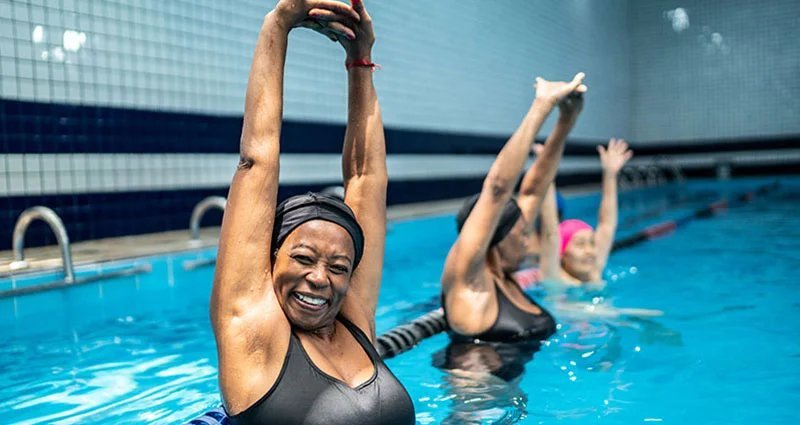
1. Swimming and aqua aerobics — the gold standard
Water supports up to 90% of your body weight, which means your knees get a genuine holiday while every muscle works. Swimming is superb cardio; aqua aerobics adds strength and sociability. Many council pools run “gentle” or arthritis-friendly sessions — the water’s usually warmer too. If you do one thing for bad knees, make it this.
2. Cycling (stationary or outdoor)
Cycling strengthens the quads — your knees’ most important support muscles — through a smooth, controlled range of motion with minimal impact. Key setup points: seat high enough that your knee has a slight bend at the bottom of the pedal stroke (too low is the classic knee-killer), low gears and high cadence rather than grinding big gears. Start with 10–15 minutes and build gradually.
3. Rowing
An underrated gem: rowing works legs, back and arms with zero impact, and the sliding motion gently mobilises the knee through its range. Keep the resistance moderate and focus on driving through the heels. Most gyms have rowing machines gathering dust — claim one.
4. Elliptical trainer
The elliptical mimics running motion without the impact — feet never leave the pedals. It’s genuinely effective cardio that most bad knees tolerate well. Use the handles for a full-body workout, keep resistance moderate, and avoid the incline function initially (it increases knee bend under load).
5. Walking on soft surfaces
Walking is technically low-impact, but hard pavements can still jar sore knees. Grass, trails, running tracks and even treadmills (which have some give) are kinder. Good shoes matter enormously — replace worn trainers, since dead cushioning transmits impact straight to joints. Shorter, more frequent walks beat occasional long marches.
6. Strength training (seated and supported)
This is the long-term fix, not just symptom management. Strong quads, glutes and calves absorb force that would otherwise go through the joint. Knee-friendly staples: seated leg extensions (light), glute bridges, clamshells, calf raises, and wall sits (shallow at first). Our guide to strengthening knees for running after 40 details the full programme — the exercises work whether you run or not.
7. Tai chi
Don’t dismiss this as “old people’s exercise” — that’s rather the point. Tai chi improves balance, leg strength and proprioception through slow, controlled movements, and trials show it reduces knee osteoarthritis pain and improves function. Many community centres run beginner classes, and there are excellent free videos online.
8. Pilates (reformer or mat)
Pilates builds the core and leg strength that unloads knees, with precise, controlled movements. Reformer Pilates (using the sliding machine) is particularly knee-friendly since much of the work is done lying down. Look for beginner or “clinical” classes and mention your knees to the instructor.
Exercises to Approach With Caution
- Deep squats and lunges: not forbidden forever, but deep knee bend under load irritates most bad knees. Shallow, well-aligned versions are fine; reassess as strength improves.
- Running on hard surfaces: pause during flare-ups. When returning, softer surfaces and shorter distances — see our guide to exercising safely with pain for the graded-return principles.
- High-impact classes: anything with jumping, burpees or deep plyometrics. Ask instructors for low-impact modifications — good ones provide them routinely.
- Stair machines: surprisingly harsh on knees. A real staircase taken slowly is usually better tolerated.
Supporting Your Knees Beyond Exercise
Weight matters enormously: every extra kilo of body weight loads the knee with roughly four kilos of force when walking. Modest weight loss — even 5% — measurably reduces knee pain for many people. Footwear: supportive, cushioned shoes; consider orthotic insoles if a podiatrist recommends them. Heat and cold: ice after activity for swelling, heat before activity for stiffness. Keep moving daily: gentle daily movement keeps joints lubricated — prolonged sitting stiffens everything up.
The NHS exercise guidance emphasises that staying active is crucial for joint health — rest is rarely the answer for chronic knee pain. And if you’re counting steps, our myth-busting guide to whether 10,000 steps are really necessary sets realistic targets.
Chair Yoga for Bad Knees: A Gentle Starting Point
If even standing exercise feels daunting, chair yoga is the perfect entry point — all the mobility and strength benefits, zero knee loading:
- Seated marches: lift knees alternately while seated tall — hip mobility and gentle core work without standing.
- Seated leg extensions: straighten one leg at a time, hold 5 seconds, lower slowly. Pure quad strengthening with the joint fully supported.
- Ankle circles and calf pumps: circulation and lower-leg strength — surprisingly important for knee stability.
- Seated spinal twists: mobility for the back and trunk, which supports everything below.
- Standing-with-support: when ready, use the chair for balance during mini-squats and calf raises — the chair removes the fear of falling, which is half the barrier.
Many community centres and the NHS offer chair-based exercise classes specifically for older adults or people with joint issues — the social element is a bonus that keeps attendance up. YouTube has excellent free chair-yoga channels; start with 10-minute sessions. The principle: meet your knees where they are today, not where you wish they were. A month of chair work builds the strength and confidence for standing exercise — and plenty of people maintain a chair-based practice indefinitely with excellent results.
The practical takeaway: swim, cycle, row or walk on soft ground for cardio; strengthen quads and glutes twice weekly; try tai chi for balance. Avoid deep loaded knee bends and high impact during flare-ups. Bad knees need movement — just the right kind, progressed gradually.





2 thoughts on “What Are the Best Low-Impact Exercises for Bad Knees?”