How to Plan the Perfect Games Night With Friends
How to plan the perfect games night with friends: choosing games, the right group size, food, and hosting tips for a brilliant evening.
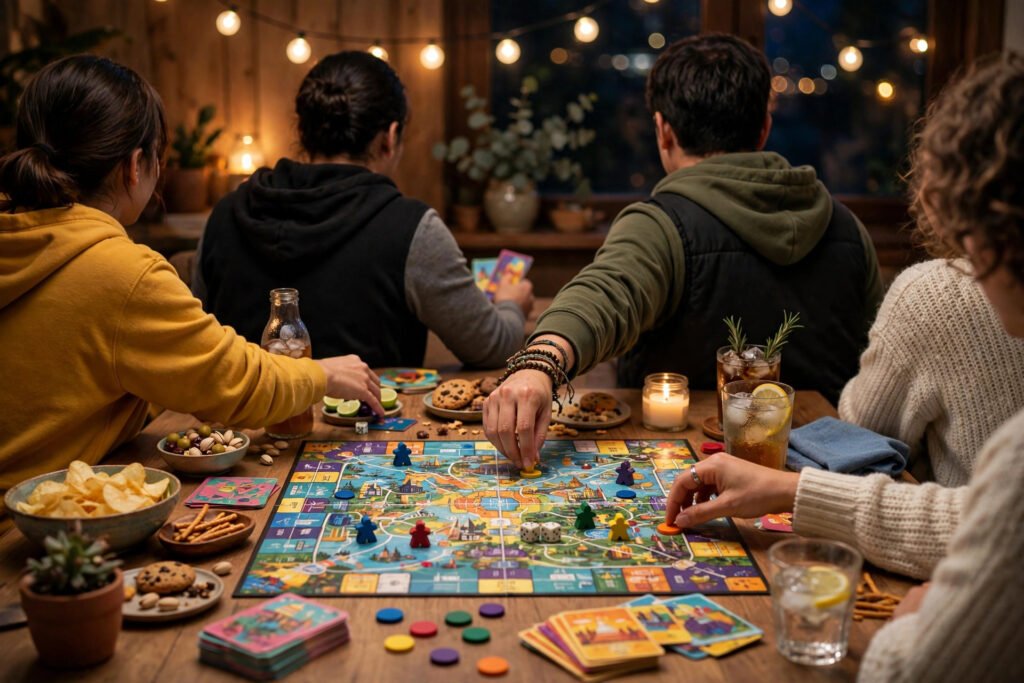
Planning the perfect games night with friends is a hosting skill worth having — done well, it’s the cheapest, funniest night out there is, and it beats the pub for actual quality time. I’ve hosted games nights for years, and the formula is consistent: the right games for the right group, good food that doesn’t interrupt play, and a host who reads the room. Here’s how to nail it.
The Guest List: Size Matters
Four to six people is the sweet spot for most games nights. Fewer than four limits your game options; more than six and you’re splitting into tables (which is fine, but it’s a different event). Invite for compatibility over completeness — the friend who sulks when losing, the one who can’t put their phone down, the rules lawyer who argues for twenty minutes: think carefully about whether they enhance the evening. Mixed groups of gamers and non-gamers work brilliantly if you choose accessible games (see below) — the best games nights convert non-gamers.
How to Plan the Perfect Games Night: Choosing the Games
The golden rule: match the games to the group, not the other way round. For a mixed group of casual players:
- Start with something quick and funny (20–30 mins): Wavelength, Codenames, or Just One. Gets everyone laughing and warmed up.
- The main event (60–90 mins): Ticket to Ride (the perfect gateway game — simple, satisfying), Carcassonne, Azul, or Catan (the classic, though it can run long and spark feuds — you know your friends).
- The late-night closer (30 mins): The Crew, Love Letter, or Cockroach Poker (bluffing game that’s hilarious when everyone’s tired).
For committed gamers, go heavier: Wingspan, 7 Wonders, Brass: Birmingham. For duos, our best two-player board games covers the couple’s night. For family crowds at Christmas, the family board games guide has the multi-generational picks.
Teaching Games Without the Lecture
Nothing kills a games night like a 25-minute rules explanation. Learn the game yourself first — play a practice round solo or watch a 10-minute “how to play” video. Teach the goal first, then the turns: “We’re building railways; most points wins. On your turn you either draw cards or claim a route.” Start playing within 5 minutes and explain details as they arise. Play an open practice round where everyone shows their cards and you coach. People learn games by playing, not by listening.
Food, Drink and the Practicalities
Food must be one-handed and non-greasy — this is the iron law of games night catering. Greasy fingers destroy cards and game pieces. Good options: pizza (eaten between games, not during), crisps and dips, cheese and crackers, slow-cooker chilli served in mugs (see our slow cooker recipes), and anything from our adult party games snack logic. Avoid: wings, ribs, anything with sauce.
Drink: beer, wine, soft drinks — the usual. Keep it moderate; the games are the entertainment, and drunk players slow everything down. Table: clear a proper table — games need space. Lighting: bright enough to read cards. Music: low background playlists only; lyrics distract from thinking games.
Hosting Like a Pro
Start on time (games nights that start at 9pm end at midnight with one game played). Have the first game set up when guests arrive. Keep score visibly — a little whiteboard adds drama. End on a high: when energy dips, switch to something short and silly rather than starting the epic. And the gracious host loses gracefully — nobody likes playing with someone who flips the table (metaphorically or otherwise).
Games for Large Groups (8+ Players)
The standard games night caps at six — but sometimes the whole crowd comes, and you need games that scale. Wavelength (2–12 players, team-based) is the gold standard for big groups. Codenames works brilliantly with 8+ split into two big teams — the team deliberation is half the fun. Telestrations (4–8, or 12 with the party edition) gets funnier with more players. Just One scales effortlessly — everyone’s on the same team. Two Rooms and a Boom (6–30 players) is the large-group masterpiece — social deduction across two rooms, chaotic and brilliant, though it needs a confident host. The quiz format (see our pub quiz guide) handles any number — split into teams of 4–6 and the evening runs itself. The key with big groups: team-based, not turn-based — anything with individual turns and 10 players means 20 minutes of waiting between your goes, which kills the energy. Teams keep everyone involved, always.
The After-Midnight Games
Every great games night has a second act — the point, usually around midnight, when the main games end and the hardcore remain. The after-midnight shelf: Cockroach Poker (bluffing, 20 minutes, gets funnier as inhibitions loosen), Love Letter (16 cards, endless depth, the perfect wind-down), Skull (the purest bluffing game ever made — beautiful, brutal, 30 minutes), and the storytelling games (Werewolf/Mafia with 8+, or The Chameleon). The vibe shifts after midnight — less competitive, more silly, more memorable. Some of my favourite gaming memories are from these late sessions: the bluffs, the betrayals, the laughter at 1am. Know when to end it: the perfect games night ends with everyone wanting more, not with everyone exhausted. When the energy dips for the second time, call it — and start planning the next one. Which? rounds up popular family and party games if you’re expanding the collection.
The Games Night Playlist (of Games)
Regular hosts develop a repertoire — the games that always work, for every group. Mine, refined over years: Wavelength (the opener — gets everyone talking and laughing within minutes), Ticket to Ride (the main event for mixed groups — nobody’s ever had a bad time), The Crew (the closer — cooperative, quick, satisfying), Codenames (the backup — works with any number over four), and Cockroach Poker (the midnight game — see the after-midnight section). Five games, every situation covered, total investment under £100 for years of evenings. Learn these five properly — teach them well, per the guide above — and you can host any group with total confidence. The repertoire is the host’s superpower: no more standing in the games shop wondering what to buy, no more rulebook panic. Five games, known cold, deployed with flair.
The takeaway: 4–6 people, accessible games in a quick-funny-main-silly arc, non-greasy food, and start on time. The perfect games night isn’t about the games — it’s about the laughing. The games are just the excuse.