
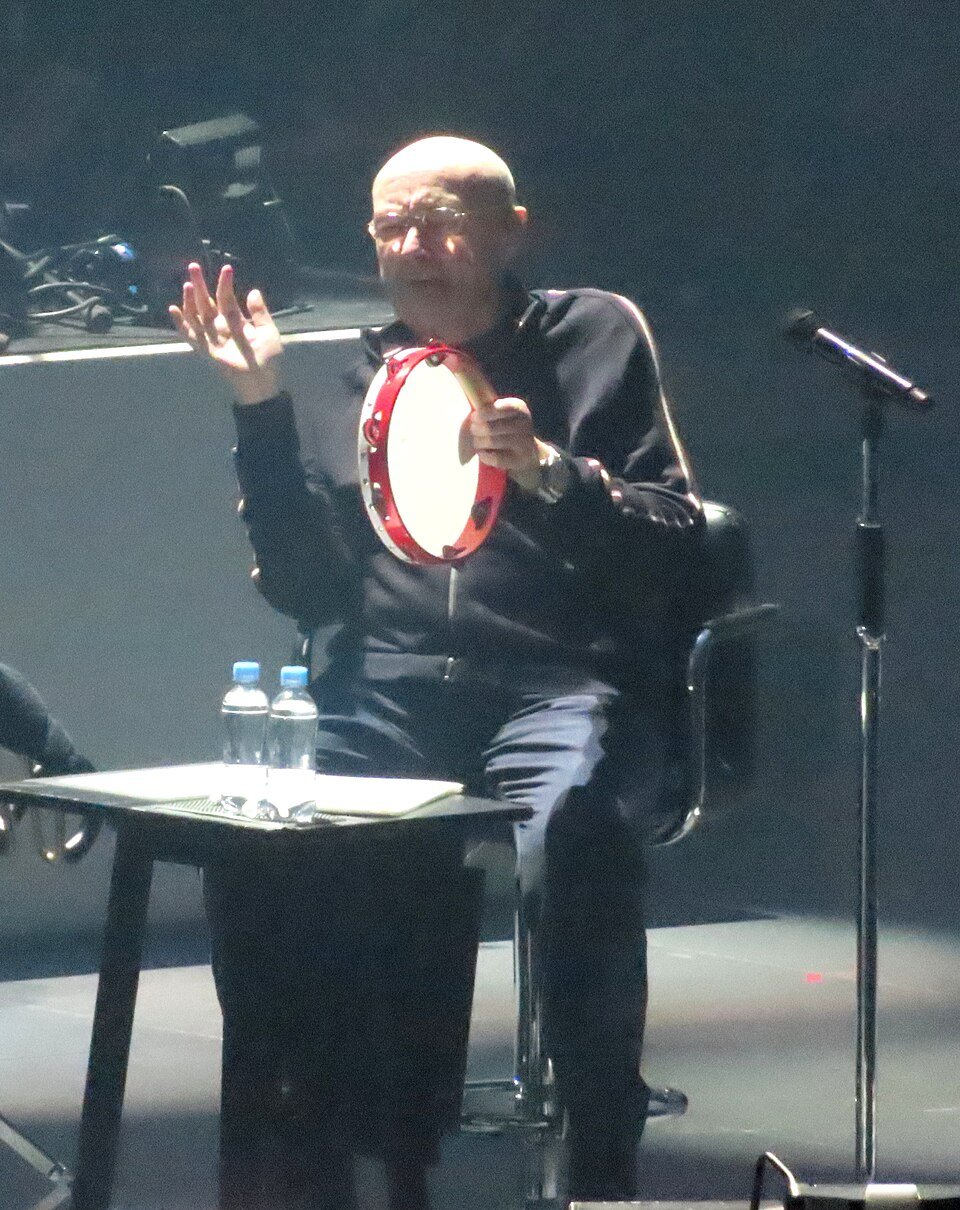
The Wealth of Phil Collins, in Full — Age, Partner, Children and Career Highlights
Starting Point: Chiswick, 1951
Phil Collins is the drummer who stepped to the front of Genesis, became the band’s lead singer, and then built a solo career that ran alongside the group for decades. Born Philip David Charles Collins on 30 January 1951 in Chiswick, London, he is 75 years old. Few musicians have held two careers of that size at once.
Celebrity Net Worth puts Phil Collins’s net worth at $350 million. That is an attributed third-party estimate, not a figure he has published himself. He is living, and in November 2026 he was inducted into the Rock & Roll Hall of Fame as a solo artist, appearing in person at the Peacock Theater in Los Angeles. Recurring reports of his death that circulate online are hoaxes, contradicted by that appearance and by reporting from major outlets.
Parents, Home and a Chiswick Upbringing
Philip David Charles Collins was born on 30 January 1951 in Chiswick, London. His birthday falls on 30 January, and he turned 75 in January 2026. His father, Greville Philip Austin Collins, worked as an insurance agent and died in 1972. His mother, Winifred June Collins, née Strange, worked as a theatrical agent and died in 2011. Between them, his parents gave him a home background that mixed ordinary office work with the edges of the entertainment business.
His mother’s work is the detail that explains the shape of his early years. Through the world she worked in, the young Collins found stage work while he was still young, learning how professional performance functioned from the inside rather than watching it from a distance. That stage work is covered here as stage work only: it was experience, discipline and an education in audiences, and it sat alongside the interest that would define his life, which was drumming.
The drums came first and stayed first. Collins was a drummer before he was anything else in music, and the commitment showed in the way he pursued the instrument through his teenage years in London. By the time he answered the advertisement that led him to Genesis, he was already a working musician with a clear sense of what he wanted: a band serious enough to match his own standards. The audition that followed, in 1970, set the course of the next half century.
The Chiswick Start, Set Out Plainly
| The Chiswick Start, Set Out Plainly | Details |
|---|---|
| Born | 30 January 1951, Chiswick, London |
| Age | 75 |
| Height | 5 ft 6 in (1.68 m) |
| Weight | No reliable published figure |
| Partner | No confirmed current partner |
| Children | Five: Joely, Simon, Lily, Nicholas and Matthew |
| Parents | Greville Philip Austin Collins and Winifred June Collins (née Strange) |
| Net Worth | $350 million (Celebrity Net Worth) |
| @officialphilcollins |
Two entries in the table deserve plain explanation. His weight is the first: figures of around 65 kg appear on aggregator pages, but none has an authoritative source, so this profile prints no number and records the position honestly as no reliable published figure. The partner entry is the second. Collins has said, in an August 2026 interview with The Sunday Times, that he would love to be in love again, which is consistent with the verified record: three marriages, all ended, and no confirmed current partner.
His height is listed at 5 ft 6 in (1.68 m), the standard figure carried for him. His Instagram account is verified under the handle @officialphilcollins.
The Breakthrough Years After Joining Genesis
1970 — Joining Genesis
Collins joined Genesis in 1970 as the band’s drummer. Genesis were then a progressive rock group built around elaborate arrangements and long compositions, and the drum chair in such a band is a demanding seat. Collins met the demand and then exceeded it, becoming central to the group’s sound. His drumming combined precision with a distinctive feel, and it gave Genesis a rhythmic identity that survived every later change of style and personnel.
Through the early 1970s the band built its reputation album by album, with Collins as its engine room and his backing vocals moving him closer to the front of the group’s sound.
1975 — Stepping to the Front of Genesis
In 1975, after the departure of the band’s original frontman, Collins became the lead singer of Genesis while continuing as its drummer. It is one of the most unusual transitions in rock history: the drummer taking the microphone without giving up the drums. Live, he sang from the kit for much of a performance and stepped forward for the rest, a physical arrangement that became part of the band’s identity.
The gamble worked commercially as well as musically. Genesis moved from progressive rock toward a tighter, more direct sound without losing its audience, and the albums of the late 1970s and 1980s carried the band into stadiums. Collins’s voice — warm, urgent and instantly recognisable — became the sound through which most of the world knew Genesis. The band’s success in this period is the first foundation of his fortune.
1981 — Face Value and the Solo Breakthrough
Collins released his first solo album, Face Value, in 1981. It established him immediately as a solo artist in his own right rather than a singer moonlighting from his band. The album’s best-known recording, “In the Air Tonight”, carried one of the most famous drum moments in popular music, a gated sound that producers and drummers have studied ever since. His solo songs had a directness that set them apart from the Genesis catalogue, and the public responded at scale.
Face Value began a solo run that, through the 1980s, matched the band’s success step for step. Albums followed in a steady sequence, among them Hello, I Must Be Going!, No Jacket Required and …But Seriously. No Jacket Required, released in 1985, was a commercial peak, and its songs — including “Sussudio” and “One More Night” — placed Collins at the centre of mainstream pop on both sides of the Atlantic. For readers tracing his albums in order, the pattern is a drummer’s solo catalogue growing until it stood equal to the band that had made his name.
1989 — …But Seriously and a Mature Solo Voice
By the end of the 1980s Collins had settled into a position almost no other musician has occupied: lead singer of a stadium band and a solo star of comparable size, simultaneously. …But Seriously, released in 1989, showed a more reflective songwriter, and its best-known recording, “Another Day in Paradise”, addressed homelessness with a directness that broadened what audiences expected from him. The album confirmed that his solo career was not a side project with a long tail but a body of work with its own centre of gravity.
The 1990s brought Both Sides and Dance into the Light, further solo albums that kept the catalogue growing even as the pace of the previous decade eased. He left Genesis in the mid-1990s to concentrate on solo work and other projects, then returned for reunion touring in later years. Each phase added recordings to a combined catalogue — Genesis and solo together — that has never stopped selling, streaming and earning.
2010 — A First Hall of Fame Induction, With Genesis
Genesis were inducted into the Rock & Roll Hall of Fame in 2010, formal recognition of the band years. A solo induction remained a separate question for another sixteen years. Retirement and return both feature in the later record: Collins stepped back for a period, then returned, and Genesis reunited for a final run of concerts in the early 2020s in which he sang seated, with his son Nicholas on drums. The catalogue work — reissues, streaming and continued sales — carried on regardless of whether he was on a stage.
2026 — Solo Induction Into the Rock & Roll Hall of Fame
On 14 November 2026 Collins was inducted into the Rock & Roll Hall of Fame as a solo artist at the Peacock Theater in Los Angeles, reported by USA Today, the Associated Press, Music Times and Consequence. He attended in person, arrived with family, and spoke. He attended with two canes, did not perform, and told the room, “I’m a well man now” and “you haven’t heard the last of me”, while accepting that his drumming days are probably done. It was his second induction, after the Genesis induction of 2010.
The induction is also the clearest possible answer to the false reports about him that circulate online. A man photographed on a red carpet, speaking at his own induction in November 2026, is living, and this profile records him as living on the strength of that reporting. In his speech he credited his assistant, Lindsay Evans; she is his assistant, and the record is stated plainly here so that the credit is not misread as anything else.
Home Life in Chiswick
Collins has been married three times, and all three marriages have ended. His first marriage, to Andrea Bertorelli, ran from 1975 to 1980. His second, to Jill Tavelman, ran from 1984 to 1996. His third, to Orianne Cevey, began with a marriage in 1999 and a divorce in 2006, with the settlement following in 2008; the two reconciled in 2016, and the relationship ended finally in 2020, when Cevey married Thomas Bates. A long relationship with Dana Tyler, running from about 2007 to 2016, also ended. The verified position today is the one given in the table: no confirmed current partner.
He has five children. Joely, who was adopted, and Simon are from his marriage to Bertorelli. Lily is his daughter with Tavelman, and has built a public career of her own. Nicholas, known as Nic, and Matthew are his sons with Cevey. Nicholas’s place in the family story is also a musical one: he played drums for Genesis on the band’s final tour, taking the seat his father could no longer occupy, which made the handover between generations a literal one on stage every night.
His parents complete the family picture in the verified record. His father, Greville, died in 1972, just as the Genesis years were beginning. His mother, Winifred, the theatrical agent whose world had given him his early stage experience, died in 2011. For readers who want the companion account from another title in this network, the full Phil Collins net worth profile sets out the same record from a different angle.
Health belongs in this section because Collins has reported it himself, and only the parts he has reported are given here. A spinal injury in 2007 left nerve damage, and he has had five knee operations. In a January 2026 BBC interview he disclosed that he has 24-hour live-in nurse care. In an interview with The Sunday Times in August 2026 he discussed an April 2024 hospitalisation linked to drinking, and the fact that he is now sober. None of this is speculation; it is his own account, and it frames the man who appeared at his Hall of Fame induction in November 2026 saying that he is a well man now.
What 1951 Started, 2026 Continues
At 75, Collins stands as a double inductee of the Rock & Roll Hall of Fame — with Genesis in 2010 and as a solo artist in November 2026 — who appeared in person to accept the second honour, told the audience he is a well man now, and said they have not heard the last of him. His drumming days are, by his own assessment, probably done, a consequence of the spinal injury and operations he has described openly. The touring chapter is closed; the catalogue chapter is not.
Financially, the position is the one set out above: a net worth estimated at $350 million by Celebrity Net Worth, resting on two catalogues, a joint catalogue transaction correctly understood, and property bought and sold at the top of the market. The gaps in the record — no reliable weight, no confirmed current partner — are stated as gaps rather than filled. On everything that can be checked, the record is consistent: a London drummer who became the voice of Genesis and a solo star at the same time, and who was still collecting honours in person in November 2026.
The $350 Million Estimate, Explained
Celebrity Net Worth estimates Phil Collins’s net worth at $350 million. No competing current total of equal standing from Forbes or The Sunday Times is carried in the verified record for this profile, so $350 million, attributed to Celebrity Net Worth, is the headline figure throughout. It is a third-party estimate assembled from a long public career, not a number Collins has issued himself.
The build-up begins with two catalogues rather than one. The Genesis catalogue, on which he played drums throughout and sang lead from 1975, and the solo catalogue, from Face Value onward, each generate recording, publishing and streaming income. Very few artists hold a writer’s and performer’s stake in two bodies of work of that scale. Add the touring income of the stadium years — Genesis at their peak and his own solo tours — and the shape of a $350 million estimate, as Celebrity Net Worth presents it, becomes understandable.
Two figures often quoted near his name need to be kept in their proper places. The first is the 2022 Concord transaction, widely reported at $300 million. That was a joint catalogue transaction involving Collins together with his Genesis bandmates Tony Banks and Mike Rutherford; it was not a statement of Collins’s personal net worth, and it is not used as one here. The second is Forbes’s 2020 Celebrity 100 figure of $45 million, which measured one year’s earnings. Earnings in a single year and net worth across a lifetime are different things, and this profile keeps them separate.
Miami Holds Phil Collins’s Main Home
On property, the verified record is specific. Collins bought a home in Miami Beach in 2015 for a reported $33 million and sold it in 2021 for a reported $40 million. Those are reported transaction prices, stated as reported. His principal home is in Switzerland, in the Lake Geneva area, and a home studio there featured in his own remarks around the November 2026 induction, when he spoke about work still to come. Property of that kind forms part of the asset picture behind an estimate of this size, but no separate value for his present home is published in the record used here, and none is invented.