How to Avoid Common Gym Injuries as a Beginner
New to the gym? Learn how to avoid common gym injuries as a beginner — proper form, warm-ups, gradual progression, balanced programming and pain signals to respect.
Joining a gym is easy. Staying injury-free long enough to see results is the hard part — studies suggest a significant minority of new gym-goers pick up an injury within the first year, and most of those injuries are entirely preventable. They’re not caused by heavy weights or bad luck; they’re caused by enthusiasm outpacing preparation. Here’s how beginners get hurt, and the practical habits that keep you training consistently instead of nursing strains.
The Big Three Beginner Injuries
Lower back strains top the list — usually from deadlifts or rows performed with a rounded back, or from “just picking up” weights with lazy form. The back is strong but unforgiving of loaded flexion repeated under fatigue.
Shoulder impingement and rotator cuff irritation come next, courtesy of bench pressing with flared elbows, overhead pressing behind the neck (just don’t), and doing far more pushing than pulling. Shoulders are mobility joints forced to act like stability joints under load — they need respect.
Knee pain — often patellofemoral (“runner’s knee”) — arrives via squats with knees caving inward, sudden jumps in leg volume, or lunging with poor alignment. Knees are honest: they hurt when tracking goes wrong.
The common thread? None of these require heavy weight. They happen at light weights with bad mechanics, repeated until something complains. If your lower back is already a concern, our guide to exercising safely with lower back pain is essential reading before you load a barbell.
Rule 1: Learn Form Before Load
Your first month isn’t for getting stronger — it’s for learning movements. Every major lift has a technique that must become automatic before weight matters:
Squat: chest up, knees tracking over toes (not caving in), weight through mid-foot, depth to at least parallel. Film yourself from the side — what you feel and what you do are often different.
Hip hinge (deadlift/row): push the hips back, keep the spine neutral, feel the hamstrings load. The classic beginner error is squatting the deadlift or rounding to reach the bar. Practise the hinge with a broomstick along your spine (touching head, upper back, tailbone) until it’s grooved.
Press: bench with elbows at roughly 45 degrees (not flared to 90), shoulder blades pinned back; overhead press with the bar path close to the face, glutes braced, no excessive lower-back arch.
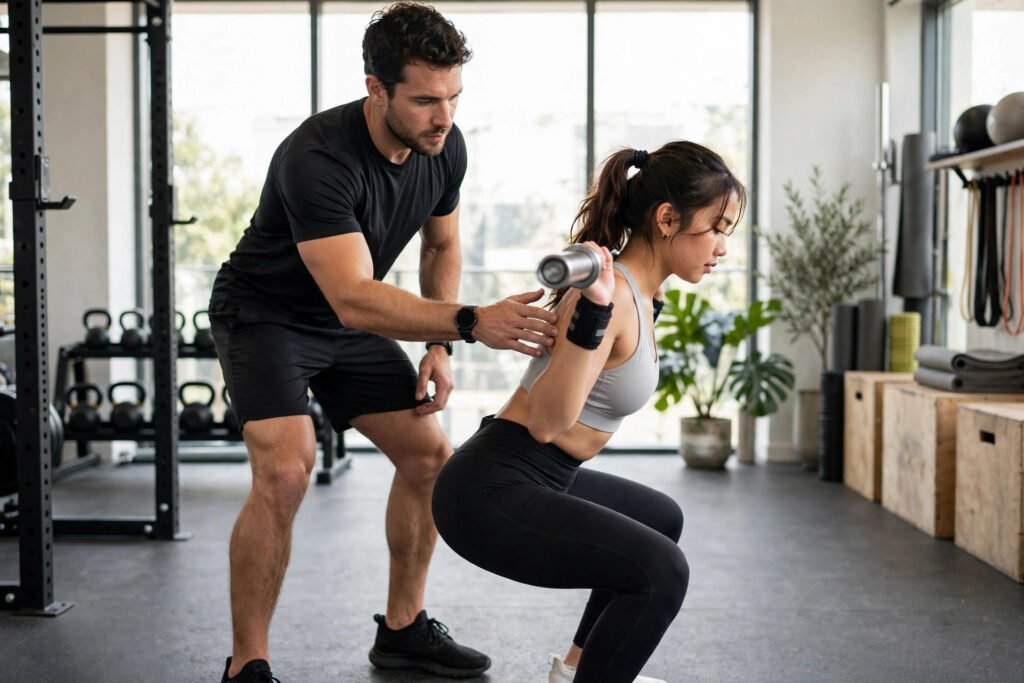
Consider two or three sessions with a qualified personal trainer purely for form coaching — not a programme, just technique. It’s the best £100 a beginner can spend. The Chartered Society of Physiotherapy also offers guidance on finding qualified rehabilitation support if niggles appear.
Rule 2: Warm Up Like You Mean It
Walking in cold and loading the bar is how injuries happen. A proper warm-up takes 8–10 minutes:
General (3–4 min): rower, bike or brisk walk to raise body temperature and blood flow.
Dynamic mobility (3–4 min): leg swings, arm circles, hip openers, thoracic rotations — moving joints through the ranges you’re about to load. Save static stretching for after; pre-workout static holds can temporarily reduce strength.
Specific ramp-up (2–3 min): empty-bar or light sets of your first exercise, gradually adding weight. Your first heavy-feeling set should never be your first set.
This isn’t optional fluff — warm muscle and primed movement patterns are measurably more injury-resistant. The ten minutes feel tedious until the day they save you six weeks.
Rule 3: Progress Gradually (The 10% Rule Is Real)
Beginner gains are intoxicating — the weights climb weekly, and it’s tempting to chase the rush. But tendons, ligaments and connective tissue adapt far slower than muscles. The classic injury story: “I added 10kg to my squat in three weeks, then my knee/hip/back went.”
Cap increases at roughly 2.5–5% per week on main lifts (often just 1.25–2.5kg), and increase only one variable at a time — weight, reps, or volume, never all three. Deload every 4–6 weeks (a lighter week at 60% load) to let connective tissue catch up. Progress you can sustain for years beats progress that breaks you in month three. If joint stress is a worry, low-impact training options let you build fitness while sparing vulnerable joints.
Rule 4: Balance Push and Pull, Upper and Lower
Beginners love mirror muscles — chest, biceps, abs — and neglect backs, rear shoulders and legs. The result is the classic imbalance injury profile: rounded shoulders, cranky rotator cuffs, knee pain from quad-dominant legs. Programme pulling (rows, pull-downs, face pulls) at least as much as pushing, train legs as seriously as upper body, and include single-leg work (split squats, step-ups) which exposes and fixes imbalances bilateral lifts hide.
Rule 5: Respect Pain Signals
Learn the difference between discomfort (muscle burn, effort, DOMS — all fine) and pain (sharp, sudden, joint-localised, or altering your movement — all stop signs). The gym mantra “no pain, no gain” is responsible for an astonishing amount of avoidable damage. Pain during a lift means stop that lift; pain that persists beyond the session means rest and assess; pain that changes how you move for more than a few days means professional assessment.
Also respect fatigue: form degrades as you tire, and the last reps of a workout are where injuries strike. When technique breaks down, the set is over — grinding ugly reps builds nothing but risk. The NHS exercise guidance reinforces the same principle: consistency at sustainable intensity beats heroic efforts.
Conclusion
Avoiding gym injuries as a beginner isn’t complicated: learn form before adding load, warm up properly every session, progress gradually enough for connective tissue to adapt, balance your programming, and treat pain as information rather than weakness. Do those five things and you’ll be the rarity — the beginner who’s still training, progressing and injury-free a year from now. The tortoise doesn’t just win this race; the hare usually ends up in physio.
The Role of Sleep and Stress in Injury Risk
Training doesn’t happen in a vacuum — the same workout that’s perfectly safe on eight hours of sleep becomes risky on five. Sleep deprivation impairs coordination, reaction time and tissue repair simultaneously, while high life stress elevates muscle tension and reduces movement quality. Studies on athletes show injury rates climbing sharply during exam periods, work crunches and relationship stress — the body keeps score across all domains. Practical takeaway: during genuinely stressful life periods, deliberately train lighter (reduce loads 10–20%, skip max-effort attempts). It’s not weakness; it’s load management. The total stress bucket — training plus life — is what overflows into injury.
Frequently Asked Questions
How common are gym injuries for beginners?
Research suggests a meaningful minority of new gym-goers experience an injury in their first year, with back, shoulder and knee issues most common. The vast majority are overuse or technique-related — and therefore preventable with proper form and gradual progression.
Should beginners use machines or free weights?
Machines are safer for absolute beginners learning movement patterns, but free weights build better stabiliser strength and transfer. A sensible path: 2–4 weeks of machines to learn the movement shapes, then transition to dumbbells and barbells with light loads.
Is it normal to feel pain when starting the gym?
Muscle soreness (DOMS) 24–72 hours after new workouts is completely normal. Sharp pain, joint pain, or pain that alters your movement is not normal — stop the aggravating exercise and get assessed if it persists.
How many rest days do beginners need?
At least 1–2 full rest days per week, and 48 hours before training the same muscle group hard again. Muscles adapt during recovery, not during the workout — rest is part of the programme, not laziness.
Do I need a personal trainer as a beginner?
Not necessarily for programming, but 2–3 sessions focused purely on lifting technique are excellent value. Alternatively, film your sets and compare against reputable coaching videos — but honest self-assessment is hard, which is where a coach’s eye helps.
Are lifting belts and knee sleeves necessary for beginners?
No — and they can mask the core-bracing and joint-stability skills beginners most need to develop. Learn to brace and move well unassisted first. Belts become useful at genuinely heavy loads later; sleeves provide warmth and mild support but don’t fix technique issues. Master the movement, then consider the accessories.