How Much Does It Cost to Rewire a 3-Bedroom House in the UK?
How much does it cost to rewire a 3-bedroom house in the UK? Prices, what affects the cost, how long it takes and how to avoid cowboy electricians.
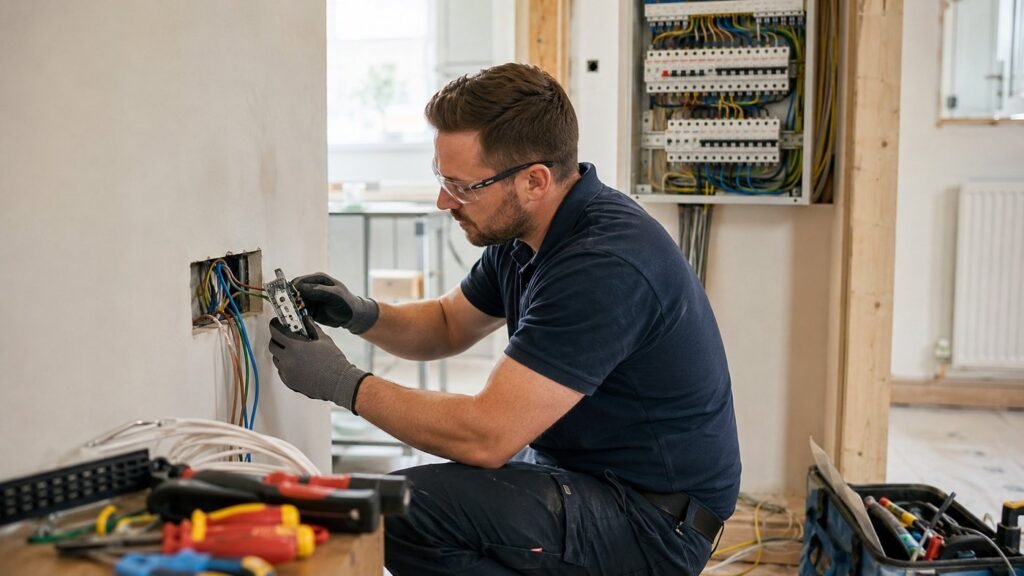
A full rewire is the most disruptive upgrade you can do to a house — floorboards up, walls chased, dust everywhere — and one of the most important. Old wiring isn’t just inconvenient (two sockets per room, fuse boxes from the 1970s); it’s a genuine safety risk, implicated in thousands of house fires a year. If your house still has rubber-insulated cable, no earth on the lighting, or a fuse box with actual fuse wire, it’s time.
Here’s how much it costs to rewire a 3-bedroom house in the UK, what drives the price up or down, how long you’ll be living in chaos, and how to find an electrician you can trust with the most safety-critical job in your home.
How much does it cost to rewire a 3-bedroom house: the numbers
For a typical 3-bed semi or terrace (around 90–110m²), a full rewire costs £4,500–£7,500 in most of the UK, including a new consumer unit, certification and VAT. London and the South East: £6,500–£10,000+. Empty houses cost less (easier access, no furniture to work around — typically 15–20% cheaper); occupied houses cost more and take longer.
What’s included at that price: full replacement of all wiring, a new 18th-edition consumer unit with RCBO protection, new sockets and switches (usually white plastic — premium fittings cost extra), new lighting circuits, mains-wired smoke and heat alarms (a legal requirement in Scotland, strongly recommended everywhere), bonding, and the all-important Electrical Installation Certificate. If a quote doesn’t mention certification, walk away.
- Typical 3-bed: £4,500–£7,500 | London/SE: £6,500–£10,000+.
- Empty houses cost 15–20% less; occupied homes take longer.
- Price must include new consumer unit, certification and VAT — confirm all three.
What pushes the price up (or down)
Size and layout matter, but the biggest variables are access and scope. Solid walls (Victorian terraces) need chasing — slow, dusty, expensive — while stud walls and lifted floorboards are quick. A house with easy loft and underfloor access is cheaper than one with concrete floors. Adding extras — garden circuits, EV charger points, data cabling, smart home wiring — adds £500–2,000 depending on ambition.
The plastering and decorating after the rewire is the hidden cost people forget: chasing walls means making good, and a full rewire typically needs £1,000–2,500 of plastering and redecorating on top. Some electricians include making-good; most don’t — clarify this in writing. Total project cost (rewire + making good) for a 3-bed is realistically £6,000–£10,000. If you’re renovating anyway, combine the rewire with a loft conversion or an extension — doing electrics once for the whole project is far cheaper than twice.
How long does it take, and can you live through it?
A 3-bed rewire takes 5–10 working days depending on occupancy and complexity. You can live in the house during it, but go in with eyes open: power will be off in sections, there’ll be dust despite sheeting, and you’ll be washing up by torchlight some evenings. Many people decamp for the worst 3–4 days — the first-fix stage, when walls are being chased.
Plan the logistics: the electrician needs clear access to every room, loft and underfloor void. Move furniture to room centres, empty the loft, and agree working hours. If you work from home, arrange to be elsewhere — the noise and power cuts make it impossible. And sort the timing: never schedule a rewire the week before Christmas or a house move.
- Allow 5–10 working days for a 3-bed; lived-in takes longer.
- First-fix (chasing) is the worst — consider decamping for 3–4 days.
- Clear every room, empty the loft, and don’t work from home through it.
Cost to rewire a 3-bedroom house: getting it done right
This is safety-critical work, so vetting matters more than price. Your electrician must be registered with a competent person scheme (NICEIC, NAPIT or ELECSA) — this lets them self-certify the work and notify building control, which is a legal requirement for rewires. Check the registration yourself on the scheme’s website; don’t take a van sticker at face value.
Get three detailed quotes specifying: number of sockets and switches per room (this is your chance to fix the two-sockets-per-room problem — go generous), consumer unit spec, making-good responsibilities, timescale, and payment schedule. Never pay in full upfront — stage payments tied to progress, with the final 10–15% on certification. And be deeply suspicious of anyone significantly cheaper than the others: rewiring has a fairly fixed materials cost, so a cheap quote means corners cut on labour, testing or certification.
- Must be NICEIC/NAPIT/ELECSA registered — verify on the scheme website.
- Three detailed quotes; never pay in full upfront.
- Beware the cheap outlier — corners get cut on testing and certification.
Signs you actually need a rewire
Not every old house needs a full rewire — sometimes a consumer unit upgrade (£400–700) and targeted fixes suffice. You likely need a full rewire if: the wiring is rubber-insulated (pre-1960s, crumbles when touched), there’s no earth on lighting circuits, you have a fuse box with rewireable fuses, sockets are cracked or sparking, or you get shocks from switches and fittings.
The definitive answer is an Electrical Installation Condition Report (EICR) — £150–300 for a 3-bed. It’s now legally required for rentals every 5 years, and it’s the best £200 a homeowner can spend for peace of mind: a qualified electrician tests every circuit and codes any faults C1 (danger present), C2 (potentially dangerous) or C3 (improvement recommended). C1s and C2s mean remedial work; a house full of them means a rewire. Get the EICR before you get rewire quotes — it turns guesswork into a specification.
- Rubber cable, no lighting earth, rewireable fuses = rewire time.
- Get an EICR (£150–300) first — it turns guesswork into a spec.
- C1/C2 faults across the house mean full rewire; isolated issues may just need fixes.
Rewiring a 3-bed house costs £4,500–£7,500 for the electrics plus £1,000–2,500 making good — serious money, but it’s a 30-year investment in safety that also modernises the house for how we actually live (sockets everywhere, proper showers, EV-ready). Get the EICR first, use a registered electrician, get it in writing, and never choose on price alone. It’s the one job where the cheapest quote is the most expensive mistake. Electrical Safety First is the charity behind much of the UK’s electrical safety guidance and is worth bookmarking.