
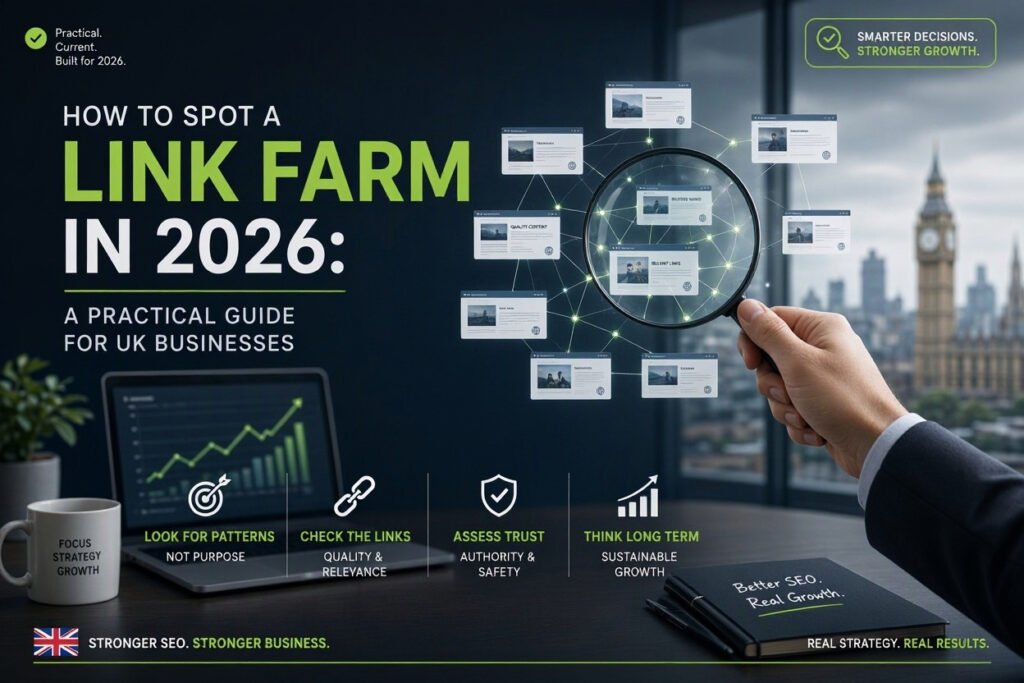
A sudden offer of dozens of backlinks for a small fee can look like an easy way to improve search visibility. The risk is that the links come from a link farm: a network of sites created mainly to sell or exchange links, rather than to serve readers. Knowing how to spot a link farm helps businesses avoid wasted spend and protect the credibility of their websites.
Links still help search engines understand how pages relate to one another, but not every backlink is a useful endorsement. Search systems can discount manipulative links, and serious violations may lead to ranking losses or a manual action. The sensible aim is not to collect the largest possible number of links; it is to earn relevant references that a real reader might follow.
What makes a site a link farm?
A link farm is a site, or a group of sites, whose main purpose is to create links that influence search rankings. Some are built solely for that trade. Others look like ordinary blogs at first glance but publish large volumes of unrelated paid articles, each pointing to a client’s website.
There is no single visual clue that proves a site is part of a link scheme. A genuine publication may cover several subjects, accept contributions or carry advertising. The concern is the pattern: little evidence of a real audience, thin or repetitive content, and links placed without a convincing reason for the reader.
How to spot a link farm: warning signs to check
- Unrelated topics sit side by side. A site publishes articles about dental care, crypto trading, garden furniture and mobile apps, with no clear editorial focus or connection between them.
- Articles exist mainly to carry links. Posts may be short, generic or awkwardly written, with a commercial link inserted into a sentence that does not naturally need it.
- Publishing volume seems implausible. A small site adds many new posts every day, often across a broad range of topics, while showing little sign of original reporting, expertise or reader discussion.
- Outbound links dominate. Pages contain numerous links to unrelated businesses, often using exact-match commercial phrases. The same sites or brands may recur across many posts.
- The audience is hard to establish. Check whether the publication has a recognisable readership, authors with credible profiles, an active community or content that people would seek out even without the links.
- Promises focus on rankings, not readers. Be cautious of guarantees such as a fixed number of links, instant ranking improvements or “high authority” placements with no explanation of editorial standards.
Use these signs together rather than treating any one as conclusive. A low-traffic specialist publication can still be valuable if it reaches the right people. Equally, polished design and impressive-sounding metrics do not prove that a site has genuine editorial value.
A simple vetting process before you pay
Start by reading several recent articles, not just the page offered to you. Ask whether the writing is useful, whether the site’s subjects make sense together and whether its links appear editorially justified. Search the publication’s name alongside terms such as “guest post” or “sponsored article” to see whether it openly sells placements at scale. Then inspect the proposed page: would your link help its audience, and would you still want the mention if search engines gave it no ranking credit?
Ask the publisher how links are handled. Paid placements should be identified appropriately, and links that are advertisements should use suitable link attributes. A provider that refuses to explain its process, asks for hidden do-follow links or guarantees search results is giving you a reason to walk away.
If you are comparing guest-post options, apply the same checks to every individual publication. A platform or intermediary does not remove the need to judge relevance, quality and transparency. Keep a record of the sites contacted, the agreed terms, the live URLs and any changes made after publication.
Safer ways to build links
For most small businesses, the durable approach is to create material that gives another site a good reason to cite you. That could be original research, a useful local guide, a clear explanation of a technical issue or a practical tool. Share it with journalists, professional associations, suppliers and relevant community organisations where it genuinely adds value.
Guest articles can also work when they are written for the host publication’s readers rather than produced as a vehicle for a backlink. Choose outlets with a coherent subject and a real editorial process. A relevant mention in a modest specialist publication may bring more qualified visitors than a link on a large but unrelated site.
Budget for promotion as carefully as for the product itself. For example, a business planning an app launch should understand development costs before deciding how much remains for content and outreach. Osdire’s mobile app cost breakdown offers a reference point for that separate planning question; it does not change the need to assess any proposed backlink on its own merits.
What to do if you find suspicious links
Do not panic over every unfamiliar domain pointing to your site. The web naturally produces links you did not request, and a strange-looking backlink is not automatically a problem. First, review whether your business or an agency deliberately paid for or exchanged links. If so, contact the site owner and ask for the link to be removed or appropriately qualified. Keep evidence of the steps taken.
For a large, clearly manipulative pattern that cannot be resolved directly, review the relevant search engine guidance before considering further action. Avoid indiscriminate disavowal: removing or discounting links without a clear reason can create more uncertainty than it solves. If rankings fall sharply or you receive a manual action notice, get experienced technical SEO advice.
The practical rule is straightforward: judge a backlink by its context, not by its promised quantity or a headline metric. If the publication would not make sense to your customers, the article would not interest its readers, and the link only exists to manipulate rankings, leave it out of your strategy.